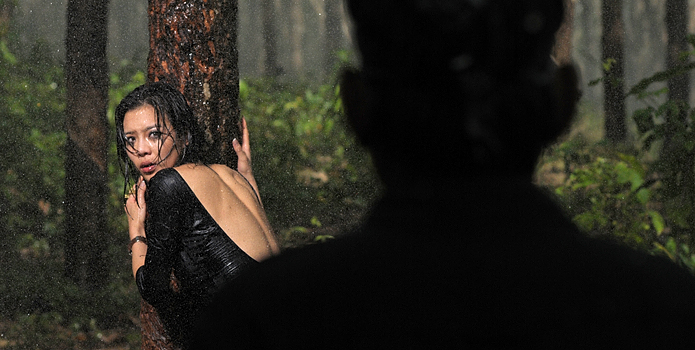
Cinema Komunisto
What happens to a nation’s cinema when the nation itself disappears? That’s the question that haunts Cinema Komunisto, Mila Turajlic’s mournful tour through the history of Yugoslavia’s national cinema. Aside from the occasional musical ode to Tito and the odd scene of bright young communists talking about how wonderful it is to do manual labour, the film largely avoids the obvious kitschy value of old propaganda. Indeed, Turajlic has little interest in exploring the tricky intersection of propaganda and reality. She also lacks the formal gusto or analytical insight to reinvigorate these films for a new time, which means all Cinema Komunisto offers is a lot of white-haired directors and actors standing in dusty warehouses reminiscing about the good old days. I came hoping for a raucous wake, but all I got was a polite eulogy.

A Simple Life
When Ah Tao, a film producer’s maid, suffers a stroke, her employer offers to pay for her residency at an old age home—it seems the only decent thing to do, considering she has served his family for 60 years. Based on the real relationship between producer Roger Lee and his maid, Ann Hui’s A Simple Life is richly rewarding and quietly moving. It’s a potentially grim subject, but Hui approaches the story with resolve and warm humour, even as she refuses to shy away from the loneliness and fear that come with aging. Shot largely under the harsh fluorescent light of a Hong Kong retirement home, the film evokes the intimacy and unvarnished look of a documentary. But this is no sweeping exploration of what it means to be elderly in modern Hong Kong, nor does Hui care to offer any thesis on the bond between Roger and Ah Tao. No, the film is nothing more or less than a gesture of respect from one human being to another, a final duty and a kindness. Simple, not simplistic.
Quattro Hong Kong 2
A short film package commissioned by the Hong Kong International Film Festival, and as varied and confounding as the city itself. The only stipulation the four directors apparently received was that they should try to film in Hong Kong, and each approached the task from strikingly different angles. However, the package kicks off with its weakest effort, an unimaginative, clumsy short from Brillante Mendoza depicting two emigrants to the city buying flowers—an older man buying for his dead wife on their anniversary, and a younger man for his girlfriend after a fight. But Ho Yuhang’s oddball black-and-white crime comedy marks a considerable improvement. Featuring python smuggling and other assorted curios, the film invests even its throwaway characters with personality and wit, creating the sense of a fully developed world in just 20 minutes. It’s charming and frequently funny, if a bit scattered.
Apichatpong Weersethakul’s contribution, on the other hand, is narrowly focused on two men sitting by the window of a single hotel room—aside from a couple of enigmatic shots of the courtyard below, we don’t see anything else. The trick is that the image is grainy and washed out, while the sound is muffled and buried beneath the burbling of water (is this life in the fishbowl?). A voyeuristic film in which there’s nothing to see, Weersethakul’s film is formally playful and even a little beautiful, but it’s also a minor effort from a major talent. The last film, from Stanely Kwan, is possibly the strongest of the bunch. Set on a bus ride into Hong Kong, it captures the divide between the city and mainland China through the overheard conversations of passengers. It’s a thoughtful, affecting work, almost as finely tuned and elegant as the music from Bach that closes out the film.
Low Life
A gloomy, doomy, dull work from Nicolas Klotz and Elisabeth Perceval, the best I can say for Low Life is that it ends better than it began. The film charts the collision between a group of undergrads and illegal immigrants, and the results are unsurprisingly sophomoric. Early scenes with the pseudo-poetic, self-absorbed Charles drain the air out of the film, and it never really comes back, although things improve considerably once focus shifts to the love affair between a young student named Carmen and Hussein, an Afghani asylum-seeker. When the French government rejects his application for asylum, the relationship between the pair becomes a kind of crime against the state, and the film becomes suddenly urgent. Chilling signs of police surveillance and oppression abound, giving the film a nightmarish quality that at last justifies the numbing dread that has been there from the get-go. But I’m really only speaking about the last half-hour or so—the rest of the film is grimly aimless and wrapped up in a punishing score that sounds vaguely like Joy Division on barbiturates. What little fire the film stirs up with its political rage is snuffed out by its flat tone and stifling moodiness.
Saturday, October 8, 2011
Friday, October 7, 2011
Vancouver International Film Festival 2011: Part Two
Bullhead
If you’ve been waiting for a searing drama about cattle hormone gangsters in Belgium, you’re in luck, because Michael Roskam has answered your prayers with Bullhead, his debut feature about a farming family drawn into the criminal hormone trade. The film is about as sturdy as Jacky, its beefy protagonist, but there’s little behind its critique of overcompensating machismo, beyond perhaps the idea that manliness is a dubious concept and best kept far away from blunt weapons. Jacky—castrated in a horrible incident as a child—gorges himself on testosterone supplements, while at the same time helping his cattle bulk up with illegal hormones. I know there’s something to be said for thematic unity, but Roskam lays it on pretty thick here. By the time we reach the end, Jacky is reduced to snorting like a bull and head-butting his enemies. What gives? Is subtlety not macho enough?
Tatsumi
Over the course of his decades-long career in manga, Yoshihiro Tatsumi has helped forge a new genre—gekiga, the dark, mature stories that he specializes in—and earned a flood of late-career plaudits as North American audiences now discover his work. But does he have to be so damned happy about it? Tatsumi’s stories are grubby and depraved, acidic and angry. His scabrous critiques of post-war Japanese masculinity and sexual mores would feels like close kin to Shohei Imamura's films (The Pornographers seems like it could have been adapted from a Tatsumi story, for instance). But despite the bleakness of much of his work, Tatsumi himself is a contented old man, grateful for a long and successful career. I’m not saying that’s a bad thing, but it certainly makes for an awkward juxtaposition with the dark, hopeless world of his art.
Unfortunately, Eric Khoo’s otherwise enjoyable Tatsumi fails to navigate that divide between the artist’s life and work. Combining biographical reflections with adaptations of five Tatsumi stories, the film reveals some striking connections between life and art, but the stories really carry the show here. Consider “Belove Monkey,” a prime bit of Tatsumi weirdness about a factory worker who loses his arm in an industrial accident and as a result must give up his pet monkey. When the man releases it into the monkey pen at the zoo, the other animals do not recognize the intruder as one of their own and viciously turn on the helpless beast. No less an outsider now because of his deformity, the man cannot even cross the street now after witnessing the slaughter of his pet. The oncoming rush of people merges in his mind with the animals in the zoo, and he is reduced to simpering terror as the monkey shrieks on the soundtrack. The whole thing borders on the ludicrous, but remains so deeply felt that it’s hard not to be affected by the revulsion expressed. Next to such violent emotion, the benign biographical sections feel out of place—cheery small talk occasionally interrupted by a scream.
Sleeping Sickness
Ulrich Kohler’s Sleeping Sickness begins as a fairly straightforward story about a German doctor working in Africa, but it soon transforms into something far stranger—a fable about the complicated, damning relationship between Europe and Africa in the post-colonial era. The early sections focus on Ebbo Velten, a German doctor running a medical program fighting sleeping sickness in Cameroon. The doctor intends to leave and return to Germany to be with his wife and daughter, but flash-forward three years and the good doctor has now gone Kurtz and disappeared into the continent. A young French doctor from the World Health Organization heads out to find Velten, who eventually reappears married to one of the locals, proud father of a newborn child. He’s become deeply entangled with the place, loving it and yet hating it, desperate to leave but unable to find a way out. This is a smart, fascinating film, and Kohler provocatively alludes to the potential damage done by Western aid. Even more provocatively, he suggests that the West may be as transformed by this codependent relationship as Africa itself. That, or else the hippos will get us all in the end.
The Sandman
Whimsical comedy-fantasies are a lot harder to pull off than they look, which makes The Sandman that much more impressive, because this film looks absolutely effortless. The premise is pleasantly weird, too: Benno, a failed composer turned haughty philatelist (is there any other kind?) discovers that his body dribbles sand whenever he tells a lie, and furthermore, said sand has the added benefit of knocking out anyone who smells it. To make matters worse, he can’t stop dreaming about Sandra, the aspiring singer who runs the cafĂ© below his apartment. Every morning, he heads down to buy a cup of coffee and insult her intelligence, looks, and talent; every night, he is beset by nightmarish visions of romantic bliss with her. Writer-director Peter Luisi keeps the film quick on its feet, and the story maintains a charming vein of dry absurdity. A few scenes mocking a phony television psychic veer a little too close to cheap sketch comedy, but otherwise this is a finely balanced and well-realized fantasy. More than a dressed-up romantic comedy, The Sandman is a surreal but keenly observant depiction of the often fraught relationship between artists.
Headshot
He’s a lover and a fighter, a cop and a killer, a Buddhist monk and streetwise punk. He’s Tul, and he’s the hero of Headshot, an elliptical hit-man saga from Thailand’s Pen-Ek Ratanaruang. Every few scenes Tul seems to be playing a different role, which could be a nod towards Buddhist notions of rebirth, or perhaps just questionable screenwriting. All of this would certainly be more palatable if the different incarnations of Tul weren’t seemingly ripped from some handbook on how to construct a generic crime thriller. The film’s non-linear structure and meditative mood spur a bit of curiosity early on, but the story wraps up in a flurry of contrivance and clichĂ© that essentially kills whatever good will the film had earned up to that point. Oh, and it should be noted that Tul sees everything upside down because of the titular shot to the head, and also that this detail is largely superfluous to the film, short of making it really difficult for the guy to drive. But sure, go ahead, toss another idea into the mix. What’s the harm in one more dead-end concept? It’s not like the film is going anywhere anyway. Wake me when this is reborn as a story I can give a damn about.
Vancouver International Film Festival 2011: Part One
Guilt
Set in the small Quebec city of Saint-Hyacinthe, Marc Bisaillon’s Guilt is a quiet story of violence and its aftermath. Two young friends—Yves, a high-school football star, and Gabriel, a bright underachiever—accidentally kill a man during a druggy, drunken night out on the town. You can guess where it goes from there: Yves doesn’t want to tell anyone, Gabriel goes along with the cover-up and is consumed by guilt, arguments are had, confessions are made, and so on. Bisaillon employs admirable restraint, but there’s no shaking the sense that there’s nothing new here. It’s a familiar tale told well, but with little imagination.
Almayer’s Folly
Liberally adapted from a Joseph Conrad novel—no, really, that’s what the credits say—Almayer’s Folly plays on the conflict between East and West, transposed to the relationship between a father and his daughter. Almayer, a European trader living in the Cambodian jungle, forces a “white education” upon his only daughter, in the process destroying his whole family. It’s a harsh portrait of patriarchal arrogance and pride, but surprisingly humane and tender as well—Almayer is both villain and victim, as worthy of pity as contempt. Employing delicately balanced compositions and fluid camerawork, director Chantal Akerman is in fine form here, turning the jungle into a kind of shape-shifting prison that refuses to give up its inhabitants. A flashback early on comes with the note that what we are seeing occurred “Before, somewhere else.” Likewise, the film refuses easy definitions and clear categories. A sometimes maddening, but strikingly beautiful work.
Kill List
Beginning as a claustrophobic portrait of a family under financial strain, Ben Wheatley’s powerful Kill List soon twists into crime thriller and finally nerve-rattling horror. When an unemployed hit man gets back into the business in order to provide for his wife and son, he discovers himself in the midst of an occult nightmare, complete with pagan rituals in which the rich and powerful hide behind straw masks and sacrifice people. From there, everything falls apart so quickly the queasy feeling in your gut won’t be able to keep up. Wheatley never loses sight of that initial family picture, however, which immediately puts the film head and shoulders above other contemporary horrors. When the going gets gory, there’s actually something at stake. These are human beings, not just sacks of meat being tossed into the grinder. Angry, righteous, horrifying and unrelenting, this is not only an ingenious genre mashup but also one of the best films to come out of the recent financial crisis. So this is what it’s like to survive in cutthroat times? Best get used to the sight of blood.
Labels:
almayer's folly,
ben wheatley,
chantal akerman,
guilt,
kill list,
marc bisaillon,
viff
Sunday, September 11, 2011
Cave of Forgotten Dreams
Being a devout technophobe and burgeoning curmudgeon, I’ve avoided 3-D filmmaking for as long as possible. In my imagination, it is not some fantastic spectacle, but rather something more like an oversized shoebox diorama where the drawings move. Too bad the bastards have discovered my weakness for Werner Herzog’s ecstatic, pseudo-mystic documentary reveries. Michael Bay better stay the hell away from my eyeballs, but I’ll at least let that Teutonic weirdo take a crack at them.
This is my way of offering a disclaimer. Cave of Forgotten Dreams, Herzog’s much-heralded documentary excursion into 3-D, is my first experience with the technology. Does it compare to Avatar, the supposed benchmark of the form? Does it even matter? Herzog is such a sui generis filmmaker that comparing him to others is futile. He’s always existed somewhere on his own personal plane of reality. What’s one more dimension at this point?
The endearing eccentricity that has turned him into a cult figurehead of late is still on display here, albeit muted. Perhaps that is due to the constraints of the filming. Given a rare opportunity to film Chauvet Cave in France, Herzog was working under tight restrictions: a small crew (himself and three others), a few battery-powered lights, jury-rigged cameras, and only a few hours a day to film, spread out over six days. Herzog narrates and interviews, throwing in the usual mystical ruminations and digressions, but he gives much of the film over to the cave’s most stunning feature: the breathtaking 32,000-year-old paintings that cover the walls.
Depicting numerous animals—from horses to rhinos and extinct creatures like cave lions and mammoths—the paintings offer a tantalizing glimpse into the Paleolithic past. Only one human figure appears, that being the bottom half of a fertility goddess. But it is the animals that rule this cave, with their calcified skeletons lying beneath the vivid portraits that depict them in full vigour. Their mouths are open, braying and howling and panting, while the ancient painters draw multiple legs to suggest movement. The walls are scraped white, resembling the bones of some giant beast. Someone says it feels like the cave watches you. No kidding.
Now 3-D might sound like a perverse choice for a documentary dedicated to filming cave paintings, but it proves to be an inspired touch. The cave walls do not offer a level canvas. They are sheets of stone billowed by time, sometimes sharp and sometimes round but never even. The 3-D captures that fluid surface, offering a distinct and subtle sense of the way the paintings occupy space. These are not flat drawings, and cannot be filmed as such.
Who would have thought there could be subtlety to 3-D? If ever there was a film technology built in defiance of nuance, this is it. Even Herzog cannot avoid all the expected gaudiness of 3-D, what with the occasional spear or stalactite jabbing the viewer in the eye. He even has a bit of fun with the technology at one point, staging a first-person shot so that it appears hands are taking off our glasses (ha ha, good one, Werner). But the cave drawings, thankfully, do not jump off the screen. They seem to writhe on the cave walls, riding the contours of the cave as they would the hills of a landscape. If this technology lets us feel as if we could reach out and touch the screen, then these paintings remain hauntingly beyond our grasp.
Amusingly, 3-D may not even be enough for Herzog. In one of those touches that could only be called Herzogian, he pauses to film the silence of the cave, allowing us to take in the drips of water, that ominous slight whooshing noise—in short, a sense of a place that can, and for centuries did, exist without a human presence. And in another oddball choice, he invites a master perfumer into the cave to smell the air. Was smell-o-vision ever on the table as a possibility?
Never one to pass up an impossible quest, Herzog has found a grand one here: attempting to comprehend human minds some 30,000 years dead. It is, as he notes, much like trying to understand the hopes and dreams of everyone in New York using only the phonebook. Far removed from our ancient ancestors, we’re mutants from the future staring into the past, trying in vain to see a reflection of ourselves. And fittingly enough, we have our own mutant form of cinema to help us along.
One of the greatest absurdities of 3-D is that a technology supposedly meant to take film into the future instead looks constantly to the past. An old novelty made new, we’re supposed to be awed by something that was discarded decades ago. But its goals are noble, if misguided and finally corrupted by the commercial desperation of studios foisting the technology on an audience jaded by decades of familiar mediocrity (at least it offers filmmakers a new way to bore us). It wants to restore some sense of wonder to the audience, and take us back to the origins of cinema, when the spectacle of images on the screen was always enough to delight and amuse.
Consider one of the legends of early cinema: audience members leaping from their seats in shock at the sight of a train coming towards them in the Lumiere brothers’ Arrival of a Train at a Station. Equally notable, if less known, is the fact that the Lumieres would remake the film in 1935 in 3-D. That train keeps coming at us, and we struggle more and more with every passing decade to feel the initial revelation that first roused us. After a certain point, you just give up and lie down on the tracks. What does it matter? It’s never going to arrive anyway.
Fortunately, Herzog does not give in so easily, and still strives to find new ways to stir us cynical audiences out of our detachment. In the film’s moving climactic sequence, Herzog falls silent and gives the film over to the paintings and Ernst Reijseger’s score. He pans slowly across the animals and lets the lights flicker and fade, evoking the torches that would have lit those images long ago. The combination of the 3-D and the shifting light gives a semblance of motion to the images. The animals prowl again in the half-light, if only for a moment. In these scenes, Herzog succeeds in taking us back to the origin of things—of film, of art, of what he terms the human soul. The cave becomes a primal cinema. The audience’s capacity for wonder, deformed by time and abuse, briefly flutters back to life.
Friday, September 2, 2011
You are Here
Do you suffer under the tyranny of Twitter? Is your life story written in status updates? Are your thoughts search engine optimized? When you picture the future, do you imagine Mark Zuckerberg’s sneaker stomping on a human face—forever? If so, you may find comfort in You are Here, Daniel Cockburn’s playfully puzzling debut feature. Perhaps best described as a droll philosophical sketch comedy, the film is an imaginative, often clever reaction to our crippling dependency on information technologies. Under Cockburn’s laser eye, the high-tech world becomes fodder for low-tech surrealism: an archive that may or may not be alive, a call centre that acts like an analog version of FourSquare, a devious genius that tricks the world into only seeing through his eyes (any similarities to the filmmaker are purely coincidental, I’m sure). Of course, it would be easy for a film about technology to turn cold and inhuman, but Cockburn wisely leaves room for the pathos of characters like the Archivist—a sensitive performance by the late, great Tracy Wright—who discover their individuality and free will slowly sapped away by the very systems meant to help them. The film offers two clear alternatives. Borne aloft by technology, we will either crash into the ground in a mess of hubris and silicon, or be carried further and further away from ourselves by our own devices. The film bets its money on the beyond, and it is not, I believe, an optimistic outlook. When our brains become but fleshy outlets for the app store, this film may be fondly recalled as the manifesto of the human resistance.
Wednesday, August 24, 2011
Submarine
Submarine begins, as these tales so often do, with a precocious, damaged boy lusting after a moody, damaged girl. You may momentarily confuse this with own your life, but I assure you that is purely an illusion borne out of repeated exposure to the legions of wounded young men who appear to grow on celluloid like some sort of fungus. Was that me or Max Fischer? Or Antoine Doinel? Maybe Leolo Lauzon? It can be so hard to recall where the screen ends and memory begins sometimes. The past is just tawdry details and still photos. Far more preferable to watch your childhood printed to film and projected in the dark, where you can’t see anyone wince at the embarrassing bits and the soundtrack is always better.
Nostalgia is a powerful seducer, and there’s nothing quite as seductive as feeling nostalgia for someone else’s childhood. All the best bits of adolescence are there to be enjoyed, all the worst laughed away—it’s not like they belong to you, after all. How remarkable it is then that Richard Ayoade manages to avoid this trap in Submarine, his able and charming debut. True, he swipes many of his best moves from the French New Wave, right down to the adolescent Anna Karina who sends our hero into a hormonal tizzy (even the typography appears to be borrowed from Godard). The whole film could easily turn into an overly mannered nostalgia trip—for childhood, for old French movies where angry young men hated the world and wanted to get laid, for Wes Anderson before he ditched Owen Wilson as his writing partner—but Ayoade’s dark wit keeps the film lively and surprising. Submarine is often beautiful and sometimes very funny, but no one is likely to wish this were his or her childhood.
For one thing, our precocious, damaged boy is actually something of a dick, as the film takes great pains to point out. Neurotic far beyond his years, 15-year-old Oliver Tate nervously monitors his parents’ marriage for signs of cracks. He even goes so far as to chart their sexual activities, where, it must be said, things look grimly flaccid. While envisioning the demise of his family unit, he throws himself into an adolescent affair with a coy pyromaniac named Jordana, only to abandon the girl as her mother undergoes life-or-death surgery. Even worse, he begins spying on his own mother, convinced she is having an affair with the ninja guru next door (turns out it was just a hand job, thank goodness). He even contemplates poisoning Jordana’s dog, partly to prepare her for the inevitably of death and loss, and partly to open up a chance to comfort her with some sweet, sweet, awkward teenage loving. Clearly, this is a disturbed child.
Does he mature in the end? Has he learned a lesson? I’m not optimistic, but I remain uncertain, which is a credit to Ayoade’s largely non-judgmental tone. He’s less concerned with navigating the rocky seas towards a dubious maturity than he is with blurring the lines between adolescent follies and adult mistakes. The director may grant these characters a kind of happy ending—not like the neighbour’s, I should add—but for a film that seems so soft on first brush there are a surprising number of barbed edges buried here. Chances are these people will go on wounding each other in new and different ways, held together only by the fact that some out there happen to love the things (or people) that hurt them. For all the film’s whimsy, there is a certain dark logic to this conclusion. Adolescence, after all, is a horrible parade of embarrassments and accidental cruelties. I’m not so sure about young love, but young masochism sounds pretty plausible to me.
Thursday, August 18, 2011
Another Earth
Deliberately—perhaps even desperately—stylish, Mike Cahill’s Another Earth tries in vain to hide a ridiculous plot and poorly conceived characters behind a lot of shaky-cam tomfoolery. Its most successful image is its simplest: a mysterious alternative version of the Earth that has appeared in the sky, lurking in the background like a watchful hero waiting patiently to swoop in and rescue the filmmakers from this mess of their own creation. And what a novel mess it is! Half Dardenne brothers’ moral drama, half Crisis on Infinite Earths, all wrapped up with a surprise! twist! ending! (tell your friends)—how many genres can a film fail in all at once? Brit Marling, who co-scripted with Cahill, stars as Rhoda, a young woman who killed two-thirds of a family in a car accident and now seeks redemption by posing as a maid for the survivor. In between doing the dishes and vacuuming, she daydreams of escaping to that alternate Earth, which remains little more than an underdeveloped distraction, one person’s vague sci-fi concept being another’s lazy plot device, I suppose. (A rocket to another planet means never having to say you’re sorry.) Key supporting characters include the mopey alcoholic crash survivor who seduces Rhoda with Wii boxing and musical saw, and a wisdom-dispensing janitor who pours bleach in his ears and eyes. Sound advice, under the circumstances.
Subscribe to:
Posts (Atom)