Saturday, July 24, 2010

Toute la memoire du monde


One might think a short film about a library could only be dry, but you should never discount the fertile imagination of Alain Resnais. Toute la memoire du monde, a 1956 short from Resnais, turns France’s Bibliotheque Nationale into a filmmaker’s playground of corridors and shadows, littered with impassive statues watching over little anonymous people who scuttle about like beetles. The institution—made into something enchantingly unreal by Resnais’ prowling camera—is alternately fortress, prison, hospital, and hive, filled with “paper-crunching pseudo-insects” (the film's charming description of readers). The collective memory of mankind is regarded with awe and even a touch of dread. There's a tone of droll wonder that is nicely accentuated by Maurice Jarre’s playfully sinister score and Remo Forlani’s witty script. The seeds of the feature-length masterpieces Resnais would make a few years later are found here, but this spryly intelligent short is more than a dry run for Hiroshima Mon Amour and Last Year at Marienbad. It is a startling piece of work in its own right, bursting with humour and insight, dropping small gems of lyrical wit along the way (the card left behind when a book is checked out is “its ghost,” the syringe used to squirt glue into damaged volumes “inoculates” the book). Does the secret of happiness lie buried within one of these haunted tomes, as the film suggests? Perhaps—or perhaps you need look no farther than this intensely pleasurable little film, which dexterously excavates the mystical from the mundane.

Sunday, July 18, 2010

Inception


Lo and behold, it’s the last original idea in Hollywood—tread carefully, lest this rare beast become startled and disappear back into the smog from whence it came. As a rare big-budget film that is neither a sequel nor based upon an old television show, Inception earns a lot of good will right from the start. True, Christopher Nolan’s story of dream thieves trying to plant an idea in the mind of the heir to a giant business empire is completely convoluted, but I’m just happy to see a blockbuster that taxes my brain and not just my senses. Too bad the film totally squanders charismatic performers like Ellen Page and Joseph Gordon-Levitt on expository sidekick roles and features Leo DiCaprio doing his typical sad-sack tortured husband routine (better than Shutter Island, for what little that’s worth). It’s an intriguing dream, yet it fades too quickly once you wake up.

Only a supremely disciplined and organized mind could hold together Inception’s complex dream-within-a-dream-within-a-dream narrative, but rationality can be a bit of a liability when dealing with the subconscious. Save for a few bursts of ostentatious special effects—a street folds on top of itself, a series of Parisian shops explode in slow motion—the dreamscapes are mostly just generic action-movie set pieces, each feeling like another level in some videogame (I’m pretty sure I already played this snow level in Modern Warfare 2). The film’s excuse is that these are collective dreams, designed by an architect and then dreamt by another. They’re meant to be generic, because anything too unique or weird draws the attention of the dreamer’s subconscious—here represented by an impersonal horde of everyday people that descend upon intruders with the implacable violence of a zombie mob. Show a bit of ingenuity and the crowd is likely to turn on you. Too much personality, too much creativity is dangerous in these blockbuster dreams. And if that is Nolan’s view of the audience and his role as an architect of dreams, is it really surprising that he should build such an elaborate labyrinth of a film to hide within?

Friday, July 16, 2010

Project Grizzly


If I were to encounter a grizzly bear—and somehow live to tell the tale—I suspect I would be changed by the experience, and probably not for the better. Most likely, I would become some sort of paranoiac anti-wilderness freak, never daring to set foot near anything that remotely resembles teeming, uncontrolled nature. City parks would reduce me to an irrational, sniveling terror. Friends would turn away in disgust as I preached the virtues of clear-cutting and forest fires. Teddy bears would send me into a rage with their vile pro-ursine propaganda.

But when Troy Hurtubise encounters a bear and is mysteriously spared, he is changed in a far different manner (though one could still debate whether or not for the better). Instead of recoiling from nature, Troy faces it head on, dedicating his life to building a suit that can withstand the assault of a grizzly. Now, as Troy lumbers about in a nearly 200-pound shell of titanium and chain mail, all I could think is one thing—what the hell is the point of this lunacy? Is he planning to walk up to a bear and punch it in the nose?

Project Grizzly dedicates itself to chronicling this baffling quest in all its absurd yet compelling glory. The film employs a somewhat cheeky tone at times, courtesy of director Peter Lynch, who seems bemused as much as he is fascinated with this man’s zealous project. When Troy and company ride into the Rocky Mountains to field-test the suit, the score turns martial, gently mocking the men’s pretense to wage war against the natural world. Nature, of course, remains completely indifferent to the petty games of men, and the group spends a week in the mountains without spotting a single bear. Only as they leave does a grizzly finally appear, but by then the suit is abandoned under a blanket of snow and playtime is over.

Lynch doesn’t try to overanalyze Troy’s obsessions, although he does allow for some tantalizing explanations. The paternal relationship is trotted out as one possibility, as the film reveals Troy’s father spent three years building a full-size re-creation of an Iroquois village (maybe monomania is genetic?). The father-son dynamic that Lynch emphasizes is almost mythic: a son seeking approval from his now-departed father. Beneath the idolization of the father there are hints of tension, and it’s hard to tell if Troy is driven by a need to live up to his father’s example or simply surpass him entirely. Notably, Troy’s nickname for the bear that almost killed him is “The Old Man.” His relationship to the animal is a mixture of awe and antagonism—a tender anger that mirrors his own relationship to his father.

If this sort of Freudian stuff doesn’t light your cigar, there’s always the adrenalin junky angle. Much talk is heard of “the edge,” the potency of adrenalin, and the need to return to that same rush first felt during some life-threatening experience. During the mountain expedition, one of the men—a Vietnam War vet, if you can believe it—talks about a game called “Outrun the Grenade” that he used to play with fellow soldiers during dull moments between battles. It’s basically what you think it is.

How else to explain cringe-inducing but often hilarious footage of Troy testing different incarnations of the suit by submitting himself to all sorts of punishment? He is rammed by a truck, battered by a log, and thrown down the Niagara Escarpment. At one point, he invites several burly bikers to beat him up with their bludgeons of choice. After their baseball bats splinter apart, he takes off his helmet and does a merry little jig to celebrate. When the log knocks him flat, he tells everyone he feels fine—better than he did before the log hit him, in fact, since his arm had fallen asleep but is now awake again.

So Troy is clearly a bit of a nut, if a charming one. These sort of charismatic monomaniacs are the bread-and-butter of the documentary form (see Man on Wire for another good example of this type of film): voluble types, somewhat self-absorbed but capable of an intense passion most people will never know. During the mountain expedition, it’s hard not to fall under the spell of Troy’s personality. As a raconteur, he’s first-class. His retelling of the bear encounter that changed his life is pure theatrics. He relives the memory as he recounts it, even throwing himself on his back when he describes how the bear knocked him down. At another point, he goes on a lengthy rant about the two knives he carries, explaining how they are necessary for protection from animals of the two-legged—as opposed to four-legged—variety. There are some real crazy folks up in the mountains, he tells us (yeah, no kidding). He then shows us how one knife is better for stabbing, while the other is for throwing.

Of course, you know that he has never had to stab a deranged mountain dweller—it’s not like there are scores of violent survivalists hiding in Banff National Park, for god’s sake—and most likely never will. This is all a lot of bluff and preparation for a threat that only really exists in his head, much as the suit is preparation for an encounter with a bear that will never come. His ambition and drive are impressive, but it’s disturbing to consider that this life-path borders so close to self-destruction (a cursory online search reveals he has already been bankrupted once by this project).

Still, there’s no denying that the suit is an incredible piece of work. Troy may be a mad mountain-man Ahab hunting his land-bound Moby Dick, but that doesn’t mean he can’t achieve great things, right? This film is pure charm, but it also illustrates the simultaneously creative and destruction power of obsession, which threatens to ruin this man’s life even as it drives him to great lengths of ingenuity. Even if reality never obliges him with the flesh-and-fur foe he craves, Troy will soldier on. Perhaps we should just be grateful that someone out there is willing to put so much effort into handling the ursine threat. After all, while he tinkers with his suit, who knows what the grizzlies are planning?

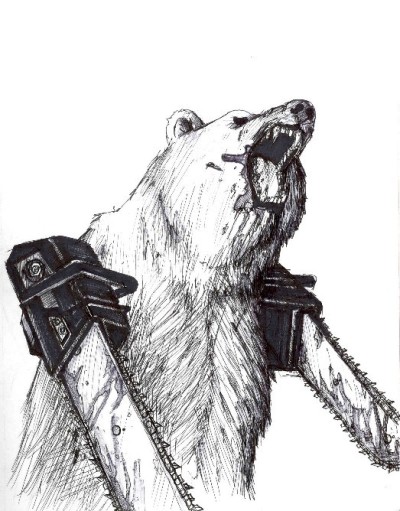
Just consider this: bears with chainsaws.

So who’s the crazy one now?

Sunday, July 4, 2010

Please Give


Most of the problems with Nicole Holofcener’s Please Give—a dyspeptic comedy-drama with little flair for either—can be summed up with a single scene. Kate (Catherine Keener), a vintage-furniture dealer riddled with guilt over her privileged lifestyle, returns a gaudy vase to its original owner because she discovers it is worth far more than expected. The man is startled by the gesture, thanks her profusely, and shuts the door. She walks away fairly glowing. Dimly on the soundtrack, we hear him shatter the vase, calling it junk.

There are two possibilities here. First, that the man is doing something utterly baffling and ridiculous—shattering a valuable vase in his living room just because it’s ugly—simply because Holofcener needs to score points against her characters. Second, that these people are aliens and this bizarre ritual would be perfectly understandable if only we could also breathe their rarified Martian air. Mundane reality, when portrayed so ineptly, becomes science fiction.

The modest premise of the film is that Kate and her husband Alex are upper-middleclass vultures, waiting for their elderly neighbour Andra to die so that they can knock out a wall and expand their apartment. While Kate’s guilt drives her to weird gestures like the vase incident, Alex is more pragmatic about his place in the food chain. Unfortunately, Holofcener tries to develop this schematic set-up (emotional woman versus rational man) with poorly realized complications, like Alex’s fling with one of Andra’s granddaughters. May the movies never again see so passionless and pointless an affair, which will neither echo through the ages nor ever besmirch my DVD player.

So I’ll break it down for you, nice and neat: the cold pragmatist learns to feel, and the sensitive type learns to not, which means everyone learns something, yay for learning (yay!). I’ve learned that it’s a horrible burden to be wealthy, successful, and happy (thank god I’ve dodged that bullet so far, whew), and I’ve learned that the best way to make such an asinine moral palatable is to resort to a lot of weepy, tinkly-piano scenes of characters hugging and telling each other that they’re good people.

I suppose there is some value to pointing out that aimless guilt does little to improve either the world or your own life. But why does a film supposedly hewn so close to life have to spend its last twenty or so minutes wallowing in pure Hollywood la-la-land nonsense? Everyone gets what they want. Kate finds release from her guilt in the joy of others. Alex’s affair ends as effortlessly and painlessly as it began. Finally, the pair buy their daughter some expensive jeans and smile beatifically in a glowing light that suggests they’re about to beam up to their spaceship and return to the planet from which they came. Farewell, friendly aliens! Enjoy your souvenirs!

Thursday, June 24, 2010

The Book of Eli


The Book of Eli reduces western civilization to two basic elements: the Bible and the iPod. Both are rather fitting touchstones for this film, considering its combination of piety with music-video aesthetics. This is empty style sanctified by strained allegory—the semblance of a good time perverted by decency.

The bearer of those two artifacts is Eli (Denzel Washington), a sort of vagabond ninja safeguarding the last remaining Bible against those who would abuse it. Wandering a wasteland America, he searches for a place where the book can be properly respected and revered. His travels are interrupted by the machinations of Carnegie (Gary Oldman providing some stock villainy), tyrannical ruler of a small settlement who has spent years searching for a Bible to help cement his power over the last remnants of humanity.

Buried somewhere beneath all this solemn sludge there is a harmless, if slight, B-movie, complete with genteel old cannibals serving their victims tea on the fine china. This material is far too ridiculous to be afforded any reverence, but the Hughes brothers suffocate it with their earnest approach. Serious only works when you have something significant to say. Instead, we have Eli acting like a cross between Jesus and Batman, dispensing of threatening goons with the slightest flick of his machete while teaching wayward women how to say grace. I have such a hard time not laughing at this that I don’t know how to trust someone who takes it seriously.

On a fairly basic level, the film doesn’t even really work. Characters fight over the Bible as if it was an atom bomb, but there’s no real reason why the book should be so significant, aside from simple Christian narcissism. After all, if Carnegie wants to enslave the desperate masses with religion, why does he need the Bible to do this? Wouldn’t any religion do? A copy of Dianetics would do the trick as well as the Bible. Considering almost no one knows about the world before the apocalypse—a rather inexplicable detail in itself—Carnegie could even preach with the aid of that surprisingly well-preserved copy of O Magazine that turns up and none would be the wiser.

Ah, but that would require a) an understanding of religion beyond the fact that some people apparently dig the Bible for some reason, and b) a sense of humour, neither of which this film possesses in any noticeable degree. This is a joyless work, not spiritual but merely pious. It uses the self-destructiveness of humanity as an excuse to peddle hope, which is comparable to—and only marginally less pathetic than—composing your own obituary as an excuse to write nice things about yourself.

Combined with The Road, this means 2009 had at least two self-serious post-apocalyptic movies too many. How many of these maudlin, masturbatory exercises must we suffer through? Each wallows in cruelty and violence only to tack on a bogus sense of uplift at the end, like a reward for sitting through two hours of washed-out brown-grey wastelands (the first victims of the bomb are primary colours, apparently). This is a rigged game from the start, stacking the odds with unabashed evil so that the untainted good is more plausible. The palette of these films is distinctly grey—the morality is anything but.

Tuesday, June 15, 2010

Man of the West


Outlaws are rehearsing for their deaths in ghost towns, each man’s death throes more dramatic than the last. This one, a mute, clutches his gut and bays animal-like through deserted streets until he’s sucking dust. That one, senile and depraved, rolls down a rocky hill when his bullet comes, twirling his arms out like a kid at play. And then the hero, their killer, folds their arms over their chests and moves on to the next.

The outlaws in this case are a cancerous brood of robbers and the hero a weary man named Link (Gary Cooper), a reformed member of the clan who must destroy his abandoned family to maintain his newfound respectability as a father and citizen (he begins the film on his way to hire a school teacher on behalf of a settlement). An autumnal western in August, Man of the West comes at the tail end of the great flowering of the genre in the 1950s, bearing a heavy sense of decline and finality in every scene. It’s like watching a play where the set is dismantled before the actors even take their bows.

Anthony Mann’s direction is at its most flexible and assured here, moving from the dense geometry of cramped interiors (trains, cabins) to the engulfing expanses of the outdoors. What matters are not the landscapes, but rather the empty spaces between people—or in some cases, the empty spaces they leave behind. When the robbers ride into a mining town called Lasso, they expect to find great wealth ripe for the taking, but instead discover a desolate frontier outpost, population one: a poor Mexican woman awaiting her absent husband.

One of the robbers shoots the woman, initiating a tensely filmed series of gun battles that leaves Link the last man standing. As he leaves the town, he passes the returning husband of the dead woman, mutters a terse “Sorry,” and rides on. The camera pulls back to capture the entire town, with Link on one side of the screen shrinking from view, diminished, while the man on the other side stands in a doorway calling out to his dead wife. You don’t look at the figures in this immense landscape portrait—just the great emptiness that surrounds and connects them both.

The whole world might as well be a ghost town now, all empty streets filled up with empty people waiting for nothing. This is a sorrow of such grand dimensions it could only exist in the dry, dusty purgatory of a western, a sorrow momentarily alleviated—but finally sharpened—by the bittersweet ending. “I know there’s no hope for us,” one ghost says to another, smiling wistfully all the same, as if this sense of loss and impossibility is the kindest thing she has ever known, and perhaps it is. “I wouldn’t change this feeling, not for anything.”

Saturday, May 29, 2010

Battle for the Planet of the Apes


It’s the year 2670 AD, and we’re in some green corner of North America where brooks still babble on, even though everyone else has run out of things to say. But a voice still begins to speak, a voice of such sinister authority it could plausibly belong to either god or the devil—no one can tell the difference between such concepts anymore in 2670, they might as well be the same thing for all it matters. And what does this mighty voice say? What proclamations, what wisdom, does it impart?

Well, I’m embarrassed to report this voice is only here to recap the plot of Escape from the Planet of the Apes before we go another barmy expedition into the monkey house. Yes, the masterminds behind Battle for the Planet of the Apes have hired John Huston to do their plot summary. Tell me, who hires such an august presence just to stick him in a Halloween mask and make him recite the plot of a cheap movie as if it were the Book of Genesis? Is this a wise way to spend your casting budget?

But such is the bizarre logic of this film, which skimps on every detail—Claude Akins’ gorilla mask looks ready to fall off his face at any moment—yet throws such a strong presence into what otherwise could be (and should be) a completely anonymous role. We’re so deep in the realms of disappointment now that we can’t find our way back to the border anymore. Out here, there are only vultures circling this walking corpse of a movie, and any notions of kitschy fun were left behind in the dunes like an empty canteen.

Almost anything would be a comedown after the revolutionary zeal of Conquest of the Planet of the Apes, but Battle, the fifth and final installment in the Ape series, is a particularly listless conclusion to the story. How can one even feel comfortable with such a benign movie after sitting through its four barbed predecessors? If the rest of the series forms a nearly seven-hour nightmare, this film is the night-light. It’s cute, reassuring, and unnecessary.

None of this is to say Battle is a particularly cheerful film, even if it does ladle some goopy love-and-harmony syrup all over its conclusion (“Peace is boring,” one character sneers, and the film unwittingly proves this). John Huston, as the Lawgiver, hangs around in the year 2670 to frame the action, which actually takes place centuries earlier in the aftermath of the fourth film. We’re on the sticky side of an undefined nuclear cataclysm that has more or less annihilated human civilization, leaving apes the dominant species, ruling over the remaining people.

Roddy McDowall returns as Caesar, the ape revolutionary from the fourth film, and his performance is one of the few remotely enjoyable things to be found in this torpid little movie. Even the flashes of misanthropic humour that characterize the rest of the series only appear here in small doses of tart smugness. The series used to make misery so much fun—now it just feels like a chore.

For instance, the law that ape shall not kill ape is broken when Aldo, a gorilla general, kills Caesar’s son (I’ll spare you a detailed exegesis on the complexities of ape politics that led to this incident). This fall from grace prompts the remark that the apes have at last “joined the human race.” Because humans are murderous monsters, you see? This is the moral of every ape film, but this marks the first time the message has been delivered in such a dutiful, automatic way. While the climactic confrontation between Aldo and Caesar carries some of that old surreal excitement—the assembled crowd eerily chants “Ape has killed ape,” as if the force of this fact alone is enough to punish the guilty—most of the film feels drained of energy and purpose.

Everything has a desultory feel, carelessly tossed off with disdain. Half of the time, we can’t even see what’s going on. The murky and poorly lit sequences that take place in the tunnels below some ruined city climax in a cloud of smoke, perhaps because director J. Lee Thompson was afraid we might actually see the movie and realize how bad it actually is.

Thompson, who also directed on the fourth film in the series, is clearly not engaging with the material this time around. Scenes begin the instant someone starts speaking and end almost before the last word has entered the air. Everything feels clipped and rushed; the filmmakers clearly can’t bear to waste one extra second of screen time on these characters. There are almost no transitions between scenes, no cushion as we jump from one flat moment to the next. The effect is such that you feel like you are being hurried through a museum moments before closing—speed walking past all the dead things.

But then again, what is there to see here? Even by the lax standards of Ape movies, the film is fairly incoherent. All of planetary life is apparently reduced to two colonies side-by-side yet completely oblivious to each other’s existence. Even more inexplicable is the fact that one of these colonies would choose to live in irradiated underground ruins, apparently preferring to starve in the dark rather than move into the lush forest right outside their cancerous hell. And somehow, in the span of a few years, apes have developed language and culture and politics. We even have hyper-intelligent orangutans discoursing learnedly on time and relativity, bizarrely, with the aid of highway metaphors. Because obviously a post-industrial society that uses horses for transport would use cars as their main point of reference, right?

Of course, I don’t go to these Ape movies looking for finely tuned narrative logic, but I feel like if I swallow one more ounce of this nonsense I’ll choke. As absurd as it is to rail against a cheap, cash-grab movie for not thinking through its plot, what I’m really bothered by is the lack of conviction and passion. I don’t ask that this movie make sense—I just want it to care.

Tragically, it all ends happily ever after. An assault on the ape-human colony ends with most of the irradiated tunnel dwellers being killed, while the few survivors form the beginnings of the bomb-worshipping cult we discovered in the second film. The militaristic Aldo dies in his final confrontation with Caesar and the humans and apes resolve to live together as equals. Then everyone hugs and some bunnies show up riding rainbows and pass the soma, it’s all good (details got a little hazy after that, but I think everyone broke into “Que Sera, Sera” at some point).

Is it wrong for me to want an unhappy ending? What I love about this dopey series is its unabashed fatalist streak. How many mainstream films can you think of from today or any other era that would dare embrace such darkness? Man is cruel, we’re all going to die—this is not the typical terrain of escapist entertainment. But there’s immense pleasure in this despair, a weirdly primal satisfaction akin to an old folk murder ballad, where all the worst impulses of humanity are dredged up like bones from the bottom of a lake and put on display. The Ape movies might as well be the cinematic equivalent of “Knoxville Girl” in the nuclear age. It’s a lament of self-defeat—an epic about how violence against others becomes violence against yourself.

Perhaps that is why this largely irrelevant coda feels so strained after listening to its four predecessors moan about death and destruction. Ignoring these demons is akin to giving in to them, making this one of the most joyless happy endings imaginable. The film succumbs to hope as if it were a fatal disease. In the final scene, the Lawgiver lectures ape and human alike about the uncertain future, but there is at least one certainty—there is no future for this series, and the movie bears that knowledge in every lifeless frame. Half-heartedly, the film preaches life and hope even as it gives up any will to carry on. A fitting conclusion to this most despairing series: this is what it looks like when a movie commits suicide.