Thursday, October 8, 2015

Vancouver International Film Festival 2015: Part One


 Arabian Nights, Volume One (The Restless One) 

The bees are dying, the shipyards are shutting down, and the director is so overwhelmed at the thought of turning such misery into art that he’s become a fugitive from his own film crew. So begins the first volume of Arabian Nights, Miguel Gomes’ ambitious three-part epic of modern Portugal in the grips of austerity. Mixing self-referential farce with sober documentary, the film gleefully cartwheels over the divide between fact and fantasy. The Restless One, the most eclectic of the three films, shows Gomes testing the limits of the robust storytelling contraption he has engineered, cobbled together from the structure of One Thousand and One Nights and fed by the findings of Portuguese journalists. In this volume alone we move from a clairvoyant talking rooster to an arson-driven love triangle acted out by teenagers and narrated in text speak. Silliness and subversion—abundant in the story of how Portugal’s political and economic leaders were cursed with permanent erections—exists alongside compassionate portraits of the country’s unemployed, who offer some of the film’s most stirring moments. The most profound rebuttal to a ruthless economic system can simply be to assert the humanity of those left outside it, and the unconscious smile on a woman’s face as she listens to her husband’s description of their first meeting holds more power than any polemic. 


One Floor Below 

Radu Muntean’s Tuesday, After Christmas was a domestic drama stretched taut until it became a thriller. His latest, One Floor Below, is the opposite: a flat, uninspired suspense setup that ends up as a pointed study of family dynamics. Sandu Patrascu, a kind of oracle of the Romanian DMV helping people navigate the punishing bureaucracy surrounding vehicle registration, overhears a violent argument between a neighbour and her lover. But when the woman is later discovered dead, he declines to tell the police about the incident, either out of shame over his voyeurism or guilt over his inaction. Enter Vali, the creepy maybe-murderer, who swiftly insinuates himself into the Patrascu family. While Sandu seems more at home jogging alone with his dog, Vali enjoys an easy rapport with the man’s family, offering computer advice to his wife and bonding with his son over videogames. From a certain angle, the tension between the two men could even be read as more a matter of jealousy than anything else. But Muntean, committed to making a sober study of a man plagued by his own conscience, dutifully follows the familiar story to its expected conclusion with little to offer that would elevate it above a dozen other routine protect-your-family thrillers. 


Paradise 

There’s only the slenderest spine of a dramatic arc in Paradise, yet every mundane moment is ripe with dread in this closely observed portrait of life for women in Iran. Hanieh, a 25-year-old single teacher living with her pregnant sister, struggles to get a transfer to a school closer to home, but director Sina Ataeian Dena is more often drawn to the cruel details that provide texture to her day. Elderly women chastise younger ones for talking to men on the bus. Groups of men make catcalls. A harsh bang that sounds like an explosion turns out to be nothing more than a soccer ball kicked into the schoolyard by a group of boys playing outside, roaming freely while the girls endure break-time in an Orwellian indoctrination factory (recess is scored by the voice of the principal barking out commands on how to dress and behave). Hanieh—portrayed with sullen gravity by Dorna Dibaj—drifts through it all in a half-numb haze, often filmed in shallow focus by Dena in order to isolate her even further from a society she loathes. Meanwhile, news of two missing girls drops from the television like a casual threat, and the film’s ambiguous final moments underscore the fear that follows Hanieh. Every stranger holds the promise of good or evil, help or homicide, and the only certainty the women can have is that he is the one who holds all power in the encounter.


The Thoughts That Once We Had 

After the festival’s screening of The Thoughts That Once We Had, Thom Andersen remarked in a Q & A that it would be his final film about film. So it should not be surprising that the film serves more as a loving compendium of the director’s obsessions than a focused essay. Taking the film theories of Gilles Deleuze as a starting point, the film launches into a distinctly personal history of cinema, making it a curious combination of academic argument and private reverie. Perhaps that explains why the film feels at times so obscurely organized as to seemingly be devoid of structure altogether. Even though the film lacks narration—too polemical, he explained afterwards—it is loosely arranged around quotes from Deleuze and others, in addition to brief textual interjections from the director himself. Not that obliqueness needs to be a complete liability, particularly when dealing with a sharp wit like Andersen. Often, the most compelling sections arise from the director pursuing his own idiosyncratic interests into such strange cul de sacs as Timothy Carey’s acting career and the similarities between Chubby Checkers and Hank Ballard’s respective versions of “The Twist.”

But does it add up to anything more than a bravura exercise in cinematic scrapbooking? Given that the director seems more interested in creating an open-ended meditation rather than a conclusive statement, that question may be impossible to answer. I would suggest that the deeply private significance of these clips—clear for Andersen, if not always the viewer—is crucial to the film’s effect, however. The orphaned quotes and stray images are like ghosts, and like ghosts each contain the flickering vestiges of something that once lived. They also contain traces of the viewer. When Andersen watches Debra Paget dance her snake-dance, he sees not only her lost youth but something of his own. Every image we consume becomes remixed in our private mental cinema, playing out in an unending loop in our imaginations and covertly tracing the shape of our own lives in the process. Every movie is a home movie.

Monday, June 15, 2015

The Second Game


Calling The Second Game a glorified DVD commentary track seems unfair. After all, who would bother to put this muddy video of a 1988 Romanian soccer match on DVD? As per every snide joke ever aimed at professional soccer, the game even ends in a riveting 0-0 tie. And while there is some ancillary entertainment value in following the players as they slip and slide their way through a snowstorm, nothing on the field can match the subtle battle of wills occurring in the conversation between director Corneliu Porumboiu and his father Adrian, the referee of the game on display. True, the pair’s debate over Romanian history and the art of soccer periodically rambles off into dead ends or dull tangents, and one has to wonder whether Corneliu even planned to release this audio when he first recorded it (the occasional ding of a cellphone notification suggests the conversation was taped under rather relaxed conditions). But the game—featuring a team associated with the army and another with the police—is also rife with the everyday absurdities of life during the twilight of the Ceausescu dictatorship, such as when the camera pans across the audience to avoid showing an on-field argument. Good communists, we’re told, are expected to play nice.

Adrian’s initial response to his son’s questioning over every detail of the match is bemused. He can’t quite understand why anyone should be concerned with a 25-year-old soccer match. The game exists to entertain in the moment. Once over, who cares? The man seems blasé about his precarious position—an opening title card reveals that a young Corneliu even received an anonymous threat against his father—balancing the egos between the rival instruments of state oppression, police and army. There is a generational divide opening up in these responses to the pained history of the Ceausescu years, with the younger generation pushing for more answers than their elders care to give. But as the film progresses, the lulls in conversation stretch out like taffy as both father and son become increasingly absorbed by the game. The father is pulled back into the match, critiquing his calls and gruffly admitting that he is enjoying the spirited play between the two teams. Still, he denies the past, and for good reason. Those long-gone days remain too painfully vivid to be embalmed in history just yet.

Tuesday, June 2, 2015

Manakamana


So much occurs within the deceptively static frame of Manakamana. Never moving beyond the four walls of a cable car riding to and from the eponymous temple in Nepal, the film consists of just 11 trips, each captured in a single uninterrupted take of about 10 minutes. Some passengers sit in an awkward silence only broken by the periodic metal-on-metal screech of the car rattling past another tower. Others idly remark upon the beautiful landscape below, play music, or bleat, in the case of a carload full of goats being transported toward their sacrificial end at the temple. Yes, there are life-and-death stakes in this humble film about people trying to sit quietly with a rooster on their lap.

The film’s restrictive concept liberates the viewer’s attention, and the world within and without the car reveals an abundance of little wonders. A bird flies past the window so quickly it vanishes like an apparition, calling to mind the disappearing bird swooping through the inner rooms of the Zone in Stalker. Blurry figures wade through the rippling waves of foliage covering the hillside or shout half-heard taunts at the swiftly moving car. In the wordless ride that opens the film, a young boy and old man—the youth agitated and uncomfortable, the elder stiff and stoic—look from side to side until the rhythms of their turning heads seem somehow choreographed. Everything is important when nothing happens.

Every detail, however innocuous, feels like a potential key to the mysterious vignettes unfolding before us, and the film invites the audience to approach each ride like a fresh puzzle to be solved. Consider one of the earlier sequences featuring a solitary woman carrying a basket of flowers. Viewers may feel a twinge of anxiety when the car jolts into motion—are we expected to just stare at this woman in silence for 10 minutes? Give it a few moments. You may notice that she is holding her basket at chest level, in an awkward position that no one could be expected to hold for the entire ride. So why does she do it here? For the camera, of course. Midway through the ride, she shifts to the centre of the seat to better frame herself for the viewer, and a brief, embarrassed smile betrays her ulterior motive before she returns to her nonchalant pose.

This episode, the second in the film, hints at the game being played by directors Stephanie Spray and Pacho Velez, who are both actually riding in the cable car with passengers. The couple carrying their rooster to sacrifice at the temple sit stiffly with downcast eyes, but it is not necessarily fear over the car’s rickety ascent that pins them to their seats. Rather, they have been instructed to not look at the camera, and they are so painfully aware of the camera’s presence that they cannot act naturally. By comparison, more experienced performers like the three metalheads inexplicably travelling with a mewling kitten—not intended for sacrifice, don’t worry—take selfies and chatter away for the benefit of the camera. What’s one more lens in their lives? Even the hum of the cable wire begins to sound like a film projector after a while. Or is that just the noise of the unseen 16 millimetre camera?

The verisimilitude of the film has been crafted for its own corruption, just as all of the trips have been carefully edited into a single continuous round trip that nonsensically goes up six times in a row, and then down five times. The directors, both veterans of the Harvard Sensory Ethnography Lab, even allow the film to run out on the final ride as the sound carries on, which only highlights the artifice binding the other sequences together. Whereas other films from the Lab aim for sensory immersion—the GoPro pandemonium of Leviathan, for example—this curious hybrid of documentary and structuralist filmmaking prefers sensory deception. Blurring of the line between performance and reality, the film reveals more about the viewer’s biases toward documentary form than anything of the customs and culture surrounding the unseen temple. If Spray and Velez are conducting an ethnographic study, then the true subjects are to be found in darkened theatres around the world, not the green hills of Nepal.

Friday, September 26, 2014

A Most Wanted Man


Slap a few horns and halos on characters and A Most Wanted Man resembles less a political thriller than a morality play, albeit one with angels and devils arguing the finer nuances of post-9/11 geopolitics while perched upon the shoulders of men. Adapted from the John Le Carre novel by Anton Corbijn, the film populates the purgatorial port city of Hamburg with those wounded by the war on terror: refugees, failed spies, idealists gone to seed. Warring tribes of spooks keep watch over two Muslims who occupy vastly different spheres of the social order. Abdullah is a prominent community leader who preaches tolerance while bankrolling violence; Issa is a Chechen washed ashore after fleeing Russian oppression, and his motives remain inscrutable beneath his shell-shocked demeanor. Anti-terrorism agent Gunter Bachmann (Philip Seymour Hoffman) tries to tempt both men towards redemption, while the U.S. attaché prefers the far simpler route of damnation. It seems you can believe in salvation all you want, but there’s no guarantee a higher power will match that faith. God is an American, and the Old Testament is clearly her foreign policy manual of choice.

But while the U.S. agent behaves as expected, Bachmann’s motives remain inscrutable for much of the film, hidden behind his wan smile as he parrots the American line about making the world a safer place. Even if he believes that cliché, his methods clearly have been deemed eccentric and naïve by his peers. Allusions to past mistakes appear again and again—the word “Beirut” is repeated several times like a penitent’s prayer—and suggest Bachmann may be more interested in saving his own soul rather than redeeming his targets. How else to explain his occasionally baffling need to offer these men the choice of amnesty over the threat of deportation? Elaborate state surveillance apparatuses typically do not spring up out of a government’s kindliness. Yet if Abdullah and Issa can be given better lives—or more accurately, coerced into accepting them—then perhaps the entire sick system can be redeemed. All of the deception and damage done in the name of peace and safety can be, if not forgiven, at least excused as ignoble means securing a noble end. If not, then Bachmann must confront the fact that he is but one more tendril of a creeping police state. The crushing final scenes of the film suggest that any such redemption is beyond reach for the man. Prisons, of course, are not built to set men free.

Tuesday, May 13, 2014

Jodorowsky's Dune


Too silly to live, yet too ridiculous to die, Alejandro Jodorowsky’s version of Dune survives now as a series of storyboards animated only by his titanic force of will. In the mid-1970s, the director gathered an estimable group of co-conspirators like Moebius and H.R. Giger—“spiritual warriors,” as he likes to call them—in order to design what now seems like the lost bridge between 2001: A Space Odyssey and Star Wars. But Hollywood was not keen on handing over millions of dollars to a surrealist oddball, which makes it all the more inexplicable that the first adaptation of Frank Herbert’s (overrated, dull) sci-fi epic should be directed by the guy who made Eraserhead. Understandably, Jodorowsky is relieved at this rival version’s cruddiness, and his gleeful schadenfreude is one of the comic charms of Jodorowsky’s Dune, Frank Pavich’s loving tribute to the lost film. With a great show of sympathy, Jodorowsky excuses David Lynch and blames the failure of Dune 1.0 on meddling producers, but there is a tinge of pride to this pity: Hollywood may have tamed Lynch, but it could not cage the great Jodo. It should come as no surprise that this man's peculiar metaphysics seemingly include the notion that everyone—but especially him—is god.

Certainly, Pavich and his faithful crew of talking heads are all too happy to indulge Jodorowsky’s genial megalomania. But a bullshit artist is an artist nonetheless, and the remarkably spry octogenarian has an enthusiasm that is hard to resist. Hearing him breathlessly describe his version of Dune is even sometimes more enjoyable than watching his films. The director, as an interlocutor of his work, possesses virtues often absent from his art: he’s giddy and jocular where films like Fando y Lis and El Topo feel weighted down with po-faced provocations and somber self-importance. Who wouldn’t sign up to a quixotic art-quest under the spell of this chattering whirlwind’s charisma? (Dan O’Bannon signs up for the project after doing drugs and becoming hypnotized by Jodorowsky’s face, apparently.) But while Pavich succumbs to the man’s charms, the audience would be advised to approach some of the stories with more skepticism. Some of the more dubious casting ideas suggest Jodorowsky is pulling our leg, or at the very least engaging in the cinematic equivalent of a fantasy football league (Orson Welles! Mick Jagger! Salvador Dali!). Still, such implausible conceits fit with the aura of impossibility that feeds the film’s enduring legend. Perhaps this is the purest expression of Jodorowsky’s surrealism—a film that exists only in dreams.

Monday, April 14, 2014

The Grand Budapest Hotel


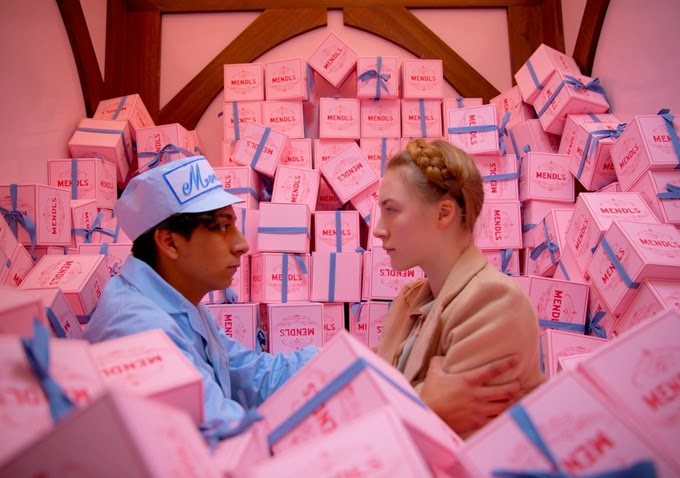
The cartoonish fancies of The Grand Budapest Hotel may appear at first like mere child’s play, but is there anyone more serious about play than a child? Wes Anderson’s latest film treats the interwar years as grist for a farcical caper, set in the whimsified European state of Zubrowka, where even the Sig runes of the SS have been transformed into the pink insignia of the no-less-threatening Zig Zag Division. Anderson crafts a world of immaculate balance and clockwork precision, but the violence of the Second World War lurks within this marvelous machinery as well (it’s all fun and games until someone loses a finger—or head). M. Gustave, the hotel’s concierge, displays a fetish for wealthy octogenarian lovers, and there is no better encapsulation of the film’s idiosyncratic combination of decay and decadence. Everyone seems suspended between the twin horrors of the two great wars, and the temptation to look down is surely hard to resist. Perhaps there are still glimmers of civilization amid the barbarity, Gustave says. But, as he also says, fuck it. Sometimes the abyss wins.

This white-capped never-never land is little more than a story of a story of something too fantastic to have even been believable in the first place, but the fantasy still succumbs to the inevitable degradations of time. Gustave’s commitment to the doomed elegance of the Grand Budapest can only mask the cracks in the foundation for so long. This is not only the illusion of grace—as his protégé Zero says—but also the grace of illusion. The film exalts in artifice while acknowledging its limits. Nothing can preserve this place, and the link between old world and new is severed with the simple tearing of a scrap of paper containing a feeble, forgotten promise of hospitality and respect. It’s a fitting symbol for the end of a place that ultimately exists only on the page: the film’s nesting doll structure leaves the vanished hotel immortalized within the pages of a book read by a girl in a cemetery decades later. All that remains of the vibrant Grand Budapest are frail words on a white page in a grey world. In a particularly striking touch, each one of the film’s different eras is filmed with a different aspect ratio, moving from a confining square in the past to a more expansive widescreen view as it nears the present. The world grows wider, yet there seems so much less to see.

Sunday, March 9, 2014

The Long Gray Line


Made during one of the more fertile periods in John Ford’s career, The Long Gray Line tends to be overshadowed by the surrounding masterpieces (The Searchers, The Sun Shines Bright) and popular successes (Mogambo, The Quiet Man). But dip into this slow-boiling vat of tears and you will find Ford’s nostalgia dissolving into a mess of contradictory emotions, ranging from despair to jubilation and every shade in between. A memory play in the mode of How Green Was My Valley and The Man Who Shot Liberty Valance, the film follows the career of Marty Maher, a West Point lifer looking back at 50 years of dutiful service with a fondness hardly in keeping with the often-painful scenes he recalls. He begins his career as an inept waiter seemingly incapable of carrying a saucer two feet without reducing it to shards, and his whole life resembles one long pratfall. Shuffling from one failure to the next, he becomes a boxing instructor who can’t box and a swimming instructor who can’t swim. The film turns what is supposed to be a triumphant summation of a life well lived into an object lesson in falling upwards. One of the film’s running gags involves Marty foisting scalp cream upon a balding student—a young Dwight D. Eisenhower. Even with one of the teacher’s most famed and successful pupils, a hint of failure lingers.

Time turns all stories to tragedies, and Marty’s is no exception. The proud tutor of great leaders becomes the bitter factor of cannon fodder. His wife and father die. He argues with a plaque of his dead mentor in the school hallways. At Christmas time, his house teems with students and well-wishers as an old song transports him to years past. Surrounded by this vibrant community, Marty seems utterly alone. Military structures overtake individual lives: the Maher line ends with the death of his infant son, while the lines of gray-suited cadets seemingly stretch into eternity. Celebration and sorrow grow increasingly tangled until we reach the film’s climactic parade, where hundreds of students march in tribute to Marty as the man’s long-departed wife and father proudly look on. The other officers glance sideways at Marty as he reaches out to this vision, and it’s hard to tell if their worried looks signal mere confusion or horror at what appears to be encroaching dementia. But what shame is there living in the past? Each one of us will take up residence there in due time.