Showing posts with label nfb. Show all posts

Wednesday, March 9, 2011

Les Raquetteurs


Watching Les Raquetteurs, a 1958 National Film Board short from Michel Brault and Gilles Groulx, I thought of a child at a wedding. The child is caught up in this social ritual he can only partly understand, and most of what he grasps are fragmentary images and sensations. He hears the music, sees the crowd, but what really stands out are pieces of the whole: a kid playing by himself on the stairs outside the hall, a couple sitting alone at a table talking. The child doesn’t realize that the couple at the table is venting frustration at the bride for snubbing a mutual friend. He doesn’t know that the kid on the stairs is hiding from his obnoxiously drunk parents, who are laughing too loud and slobbering all over each other. These glosses of meaning can come much later, when the scene is reconstituted in memory. But in the moment, it’s just an experience.

Les Raquetteurs, documenting a snowshoeing festival in Sherbrooke, Quebec, captures some of that childlike wonder and confusion. At times, I felt like a baffled kid standing next to my mother. Mom, why are the snowshoers running on a track instead of snow? (Answer: because it’s funnier that way, dumbass.) The film is a concentrated pill of the festival’s pleasures, ranging from the opening parade to the races, with a rowdy evening dance closing out the festivities. It’s a goofy little event—seriously, the racetracks are so well trod the racers could just as easily be running on dirt—but Groulx and Brault film everything with a delighted fascination. The film stands as an early exemplar of direct cinema.

A brief explanation: direct cinema is an approach to documentary filmmaking that has roots in Quebec, and Les Raquetteurs lies right at the origins of the movement. The goal is to give viewers a taste of an unmediated experience. Direct cinema typically forgoes voiceovers and other explanatory devices that can pull the viewer out of the film (there are no labels here telling us who these people are, for instance). There is just the subject, with as little interference as possible. Compare that to a more conventional documentary, which uses talking heads and a narrator to help capture reality. That word says it all—“capture.” You could say confining a subject is one route to understanding it; you could also ask how well a warden can ever know his prisoners. Direct cinema simply aims for a freer relationship with reality, that’s all.

Of course, that doesn’t mean the film is necessarily more real—whatever that is—than other documentaries. Brault and Groulx are certainly not above a little bit of manipulation, if it suits their purposes. There’s a hilarious offhand moment when a train interrupts the town parade, leaving one half of a befuddled marching band stuck behind a string of rail cars. An unplanned moment, sure, but what of that perfectly framed shot of the railway crossing lights flashing? Orson Welles supposedly once said that a director presides over accidents. I don’t suppose that means reading the train schedule each morning and then setting up your camera at the railway crossing.

Perhaps Brault and Groulx cheat a little—so what? Who wants to get into phenomenological haggling over what is and is not a valid experience of reality? At its best, the film is a joyous rush of images, made all the more vivid for their lack of context: the banjo player caught in mouth-agape ecstasy mid-song, the awkward staged kiss between the queen of the festival and the man who presents her crown, the dancing harmonica player who flails with pure abandon. I’m particularly fond of the man who trips and loses a race, angrily throwing down his toque and then picking it up in almost the same gesture, as if instantly embarrassed by his outburst. A couple of staged shots do nothing to detract from this sense of spontaneity. The film is nearly 15 minutes worth of unguarded moments.

At the party that closes the film, we see several different couples whispering into each other’s ears. Of course, we never hear what is said, and that’s part of what makes the images stick in the mind. Much like that child at the wedding, these experiences are more vivid precisely because we don’t know everything. Understanding is itself a filter between yourself and experience. Sometimes documentaries try to show us reality by holding it down and prying out it secrets. But in the best examples of direct cinema, the surest way to reveal the world is to preserve something of its mystery.

Friday, July 16, 2010

Project Grizzly


If I were to encounter a grizzly bear—and somehow live to tell the tale—I suspect I would be changed by the experience, and probably not for the better. Most likely, I would become some sort of paranoiac anti-wilderness freak, never daring to set foot near anything that remotely resembles teeming, uncontrolled nature. City parks would reduce me to an irrational, sniveling terror. Friends would turn away in disgust as I preached the virtues of clear-cutting and forest fires. Teddy bears would send me into a rage with their vile pro-ursine propaganda.

But when Troy Hurtubise encounters a bear and is mysteriously spared, he is changed in a far different manner (though one could still debate whether or not for the better). Instead of recoiling from nature, Troy faces it head on, dedicating his life to building a suit that can withstand the assault of a grizzly. Now, as Troy lumbers about in a nearly 200-pound shell of titanium and chain mail, all I could think is one thing—what the hell is the point of this lunacy? Is he planning to walk up to a bear and punch it in the nose?

Project Grizzly dedicates itself to chronicling this baffling quest in all its absurd yet compelling glory. The film employs a somewhat cheeky tone at times, courtesy of director Peter Lynch, who seems bemused as much as he is fascinated with this man’s zealous project. When Troy and company ride into the Rocky Mountains to field-test the suit, the score turns martial, gently mocking the men’s pretense to wage war against the natural world. Nature, of course, remains completely indifferent to the petty games of men, and the group spends a week in the mountains without spotting a single bear. Only as they leave does a grizzly finally appear, but by then the suit is abandoned under a blanket of snow and playtime is over.

Lynch doesn’t try to overanalyze Troy’s obsessions, although he does allow for some tantalizing explanations. The paternal relationship is trotted out as one possibility, as the film reveals Troy’s father spent three years building a full-size re-creation of an Iroquois village (maybe monomania is genetic?). The father-son dynamic that Lynch emphasizes is almost mythic: a son seeking approval from his now-departed father. Beneath the idolization of the father there are hints of tension, and it’s hard to tell if Troy is driven by a need to live up to his father’s example or simply surpass him entirely. Notably, Troy’s nickname for the bear that almost killed him is “The Old Man.” His relationship to the animal is a mixture of awe and antagonism—a tender anger that mirrors his own relationship to his father.

If this sort of Freudian stuff doesn’t light your cigar, there’s always the adrenalin junky angle. Much talk is heard of “the edge,” the potency of adrenalin, and the need to return to that same rush first felt during some life-threatening experience. During the mountain expedition, one of the men—a Vietnam War vet, if you can believe it—talks about a game called “Outrun the Grenade” that he used to play with fellow soldiers during dull moments between battles. It’s basically what you think it is.

How else to explain cringe-inducing but often hilarious footage of Troy testing different incarnations of the suit by submitting himself to all sorts of punishment? He is rammed by a truck, battered by a log, and thrown down the Niagara Escarpment. At one point, he invites several burly bikers to beat him up with their bludgeons of choice. After their baseball bats splinter apart, he takes off his helmet and does a merry little jig to celebrate. When the log knocks him flat, he tells everyone he feels fine—better than he did before the log hit him, in fact, since his arm had fallen asleep but is now awake again.

So Troy is clearly a bit of a nut, if a charming one. These sort of charismatic monomaniacs are the bread-and-butter of the documentary form (see Man on Wire for another good example of this type of film): voluble types, somewhat self-absorbed but capable of an intense passion most people will never know. During the mountain expedition, it’s hard not to fall under the spell of Troy’s personality. As a raconteur, he’s first-class. His retelling of the bear encounter that changed his life is pure theatrics. He relives the memory as he recounts it, even throwing himself on his back when he describes how the bear knocked him down. At another point, he goes on a lengthy rant about the two knives he carries, explaining how they are necessary for protection from animals of the two-legged—as opposed to four-legged—variety. There are some real crazy folks up in the mountains, he tells us (yeah, no kidding). He then shows us how one knife is better for stabbing, while the other is for throwing.

Of course, you know that he has never had to stab a deranged mountain dweller—it’s not like there are scores of violent survivalists hiding in Banff National Park, for god’s sake—and most likely never will. This is all a lot of bluff and preparation for a threat that only really exists in his head, much as the suit is preparation for an encounter with a bear that will never come. His ambition and drive are impressive, but it’s disturbing to consider that this life-path borders so close to self-destruction (a cursory online search reveals he has already been bankrupted once by this project).

Still, there’s no denying that the suit is an incredible piece of work. Troy may be a mad mountain-man Ahab hunting his land-bound Moby Dick, but that doesn’t mean he can’t achieve great things, right? This film is pure charm, but it also illustrates the simultaneously creative and destruction power of obsession, which threatens to ruin this man’s life even as it drives him to great lengths of ingenuity. Even if reality never obliges him with the flesh-and-fur foe he craves, Troy will soldier on. Perhaps we should just be grateful that someone out there is willing to put so much effort into handling the ursine threat. After all, while he tinkers with his suit, who knows what the grizzlies are planning?

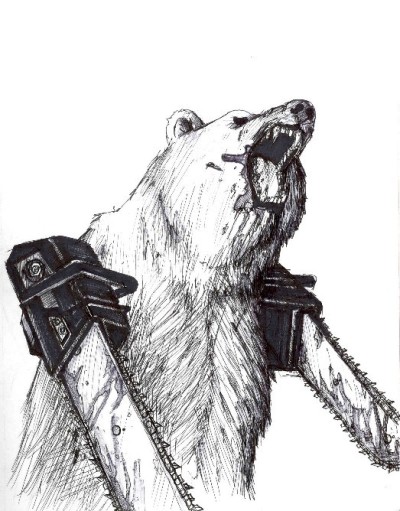
Just consider this: bears with chainsaws.

So who’s the crazy one now?

Thursday, March 19, 2009

NFB Film of the Week: Flutter


Films like Howie Shia’s Flutter remind me of what makes animation so attractive a medium—a distinctive artistic style put into motion in order to tell a tale primarily in images, albeit aided by music, sound effects, and the occasional sub-linguistic noise. This is prime visual storytelling, and is that not the essence of all good filmmaking?

The film takes off from a single striking image: a boy with paper wings glued to his sneakers. The boy lines up for a schoolyard race, jumps the gun, and then leaps the fence, heading out of the schoolyard as his baffled teacher helplessly blows the whistle and his classmates watch in confusion. He runs and runs—through the urban landscape, leaping over cars and buildings, into the countryside, racing through wheat fields and alongside buffalo—until he reaches a vast body of water. With the stars reflecting in the water, the night sky and the ocean seem indistinguishable from each other. So the boy simply keeps running, across the water and into the sky.

At the same time, a friend of the boy—a female classmate—takes inspiration from his escape and spray paints a huge mythological mural on the side of a building in the city before being chased away by a resident of the place. The boy’s act of rebellion inspires the girl to her own defiant act of creativity, one great deed inspiring another.

Shia’s animation style is fluid and simple—perfect for capturing the more pronounced movements of his characters as well as their more subtle expressions. The film is primarily in black and white, except for flashes of red when the boy cuts himself as he runs through the wheat field. The backgrounds are dark, imposing shapes that bring into relief the figures, which are drawn with a clean line, turning them into little pools of white space that attract the eye in the threatening urban landscape.

True, this is a modest film. Its goal is simply to celebrate creativity and rebellion with the energy and imagination such themes deserve. But even a modest animated short can attain some powerful effects that are beyond the capabilities of live-action filmmaking simply through the sheer expressiveness of its line or the shifting moods of its different shades of grey. Consider this quote from Rudolf Arnheim, who wrote in his book Film as Art, “I would venture to predict that the film will be able to reach the heights of the other arts only when it frees itself from the bonds of photographic reproduction and becomes a pure work of man, namely, as animated cartoon or painting.” Arnheim, an old-guard theorist writing during the transition into sound in the 1930s, essentially argued that film was an art inasmuch as it diverged from reality. The artistry of the medium lay in its manipulations of reality, not its photographic reproduction thereof. Colour, dialogue—these were the problems, not the solutions.

This stance might sound a bit perverse to audiences today, but considering the limitations of early sound films, which felt comparatively shackled next to the sublime gracefulness of the late, great silents, it’s an understandable if ultimately futile argument. Time marches on, and once people start talking it’s a bit hard to shut them up.

I bring all of this up not because I want to subject this humble animated short to some sort of lofty theoretical analysis—god forbid I should be so cruel to any film, never mind one as charming and beautiful as Flutter—but rather because I want to celebrate its nimble visual storytelling. Animation is really the last bastion of this type of filmmaking where everything can be expressed without words and no one will bat an eye. Film as a medium is at its most distinguished when conveying ideas and emotions through images—that much better to say things that are beyond words. If dialogue driven films most closely resemble novels, then visually driven films most closely resemble music. Sing it, Shia, sing it!

Wednesday, March 11, 2009

NFB Film of the Week: Paul Tomkowicz: Street-railway Switchman

Digging through these National Film Board archives, I find myself constantly discovering these films that might appear bland on the surface, but which reveal surprising reservoirs of emotion. Take Roman Kroitor’s Paul Tomkowicz: Street-railway Switchman as an example. It seems like a rote piece of nationalist filmmaking: part of the “Faces of Canada” series, it focuses on the titular character, a hard-working Polish immigrant who works as a switchman in Winnipeg. Set in the middle of a rather chilly looking winter’s night, the 64-year-old Tomkowicz sweeps the snow from the streetcar tracks and provides a dry narration that recounts bits of his past and mundane details of his present routine. But the film’s winter imagery—of whitened streets beneath the black night, lights surrounded by a halo of snow—evokes the beautiful quietude of walking a Canadian city in the depths of a cold night, that sweet melancholy state before the frostbite kicks in.

This brief character study unsurprisingly takes on the same desolate qualities as its setting. Observing that he can safely walk Winnipeg’s streets at any hour of the night, Tomkowicz explains in a clipped, restrained voiceover, “My sister wrote me in my village in Poland the soldiers came in one night and murdered 29 people—my brother, my brother’s wife.” It’s a shocking detail, but even more startling is how detached the man is as he describes the death of his own relatives. “Why they do that?” he asks. “I don’t know.” As he speaks, the tone in his voice sounds no different than when he later contemplates smoking his pipe and reading the paper on his day off.

The rest of the voiceover is delivered in a similarly dispassionate tone. This can at least be partially contributed to the fact that Tomkowicz is no professional actor, and like most non-professionals, he becomes self-consciously inexpressive and controlled when being recorded. Not that this is a deficiency in the film—if a director like Robert Bresson could wring potent emotions out of the non-emotive amateurs in his films, then why not this film?

In fact, Tomkowicz’s lack of emotion as he describes his life is what gives the film its surprising emotional impact. The voiceover has the quality of an internal monologue—it skips around seemingly at random, jumping from quotidian musings about what he will do on his day off to thoughts of mortality as if the two were interchangeable notions, each of no greater significance than the other. Tomkowicz mentions that the streetcars will be replaced by trolley buses, effectively making the switchman obsolete. He sounds unperturbed by this turn of events, noting that he will be retired before the trolleys drive him out of a job. But his thoughts continue on this declining track and he considers the possibility that at 64 he might not have many years left: “Maybe another couple of years—finished. I don’t know.”

Of course, even after making this observation, Tomkowicz goes on to sketch out things he can do when retired, so if it sounds like I’m obsessing over the man’s death, at least take comfort in the fact that he doesn’t seem particularly bothered by the prospect of that last streetcar ride into oblivion. His mortal thoughts come and go as casually as those passengers whose faces occasionally light up the film with the promise of a bustling, dynamic world somewhere far away (and warm too, I’ll bet)—somewhere outside of the serene, lonely world of Paul Tomkowicz.

Thursday, March 5, 2009

NFB Film of the Week: The Street


Based upon the Mordecai Richler story “The Summer My Grandmother Was Supposed to Die,” Caroline Leaf’s animated short The Street tells the story of a young Jewish boy in Montreal forced to share a bedroom with his older sister while his grandmother lies slowly dying in the room that he believes should be his. The film has the feeling of a memory revisited, grounded in concrete details of everyday life but filtered through the shadings of perception—an effect aided by Leaf's distinctive animation style of using water paint on glass (she mixes glycerine in the paint to prevent it from drying). The images flow from one to another, and the heavy, wet paint gives the visual style a distinctive sense of texture and a remarkable sensitivity to nuances of light and movement. Consider this Impressionist animation.

This style of animation, which avoids hard cuts between scenes and instead allows the images to constantly transform, is hardly unique in itself. In fact, there is a long history of it at the NFB. Leaf was likely influenced by the NFB’s resident innovative animator, Norman McLaren, who could build a short film simply out of the transmutations of a single doodle (see Hen Hop for just one example). Or, for a more recent example from outside the confines of the NFB, you can look at Josh Raskin’s I Met the Walrus, which uses the continuous transformations of its images to illustrate an old conversation with John Lennon. The mutating visuals in these films carry some of the charge you would find in a particularly long, unbroken shot in a live-action film, even if the effect is ultimately dampened by the lack of narrative (it’s hard to have a sense of lived time in an abstract film). Regardless, this style creates a sense of unbroken time, as opposed to the elliptical time created by editing.

But The Street feels like a fortuitous meeting of style and story. The fluid transformations are an approximation of memory, condensing a span of years into a series of vividly recalled moments that carry the emotional weight of a larger story. These small moments—the boy’s confused cry of “Who’s getting married?” after being told his grandmother left a ring behind for his wife, for example—are the sort of incidents that seem to grow upon recollection, gaining significance over the years as you try to impose order and meaning upon the past.

In one of this short film’s most beautiful sequences, two men at the funeral stand on the balcony ruminating upon how cruel it is that there should be such sorrow on so beautiful a summer’s day. The view shifts to the whole of the street, complete with children riding on bicycles and sheets on clotheslines flapping in the breeze, before returning to the two men on the balcony. The sun sets almost instantly; the sky rapidly shifts colours before fading to black. The vividness of the summer day is made poignant by the overwhelming sense of transience that hangs over it.

The film ends with a similar juxtaposition of vitality and decay. After his grandmother passes away, the boy’s sister declares that he will at last have a room to his own, but that long-held desire no longer appeals to him. Now the boy dreads sleeping in the bed where his grandmother died. As he tries to sleep, his sister dances around the room wearing a sheet and moaning in the voice of their dead grandmother, “Who’s that sleeping in my bed?” The boy has gained his first glimmer of his own mortality, with old age hanging over his own youth like a wraith. In this film, as in memory, time is simultaneous.

Thursday, February 26, 2009

NFB Film of the Week: I Was a Ninety-pound Weakling

It can be tough selling people on physical fitness. It isn’t that we don’t know exercise is a vital part of a healthy lifestyle—we know, we know. The problem is that we know it’s a vital part of a healthy lifestyle, and yet still we don’t embrace it. How do you sell something that is free and good for people, but requires some form of effort, however simple? Imagine if the only currency accepted by grocery stores were push-ups done on the spot. My friend, half the human race would starve to death and the other half would be ripped and smug about it.

I Was a Ninety-pound Weakling approaches this problem of promoting fitness with admirable cheekiness. Directors Wolf Koening and Georges Dufaux use a mixture of interviews and staged footage to construct a likeable comic essay that hides its public-service message behind irreverence. This documentary is undoubtedly good for you, but its little touches of sardonic humour make it go down like a chocolate shake.

“Our civilization is being swamped by a tidal wave of unprecedented luxury and ease,” we are warned by the narrator, and the film explores a variety of fitness cultures combating this tidal wave, ranging from wrestling to bodybuilding to Yoga. The film is modestly informative, but it seems less like a hard documentary than a light essay on the topic of physical fitness, using that subject as an excuse for exercises in humour and style, like any good essayist would do. Often, the humour resides in the film’s wry juxtapositions. For instance, when a man running a gym declares that “life is a tough thing” and we must be physically fit to meet its demands, the film illustrates this statement by showing a man running across a street. Only the strong will survive (jaywalking)?

Of all of the interview subjects, the people involved with “passive exercise” are most open to ridicule. The camera lingers on the overweight butts strapped into the vibrating machines, the flab jiggling hypnotically, as a way of suggesting the questionable merit of this process (or else simply indulging a rather particular fetish). The man running the facility makes grandiose statements about the fall of the Roman empire, but when one of the employees tries to explain how the machines work, she continually stumbles over the laboured sales pitch. If our society is collapsing because of obesity, you think they could at least memorize the salient points of our salvation.

The film drives its point home with the purely illustrative scene that follows: a man at a driving range uses an automatic ball drop, which promptly breaks down and starts overrunning his tee with too many balls. As the narrator dryly notes, mechanical or physical means may not be enough to solve the fitness problem. From this point, the film moves in to the realm of Yoga, which opens up questions of spiritual fulfillment in the quest for health while allowing the filmmakers plenty of opportunity to gawk at the impressive flexibility of the instructor.

The overall tone of I Was a Ninety-pound Weakling, as I noted earlier, is comic and light. Even as they convey the urgency of physical fitness by declaring “every time a machine robs us of the work a muscle used to do, we get a minute fraction weaker,” they self-mockingly illustrate the point with ominous images of automatic doors opening. This sort of technique—footage that deflates the grand claims of the narrator or interview subjects—might make it seem as if the filmmakers were subverting their ostensible goal of promoting fitness, but in fact it’s just the opposite. With subtle humourous pokes at various fitness subcultures, the film aligns its sympathies with the out-of-shape audience member skeptical at the sight of middle-aged men flashing their taints at the camera as they sprawl on a wrestling mat, all while the coach raves excitedly about the concept of “pep” and declares the nation would be better if it had more wrestlers in it.

Who wouldn’t be a little wary of the most gonzo elements of any subculture? Sure, I want to be healthy too, but does that really require strapping myself to some sort of torture device called a “Miracle Machine”? Forget about slimming thighs—the miracle is that it’s even legal. So the film indulges our skepticism and allows us a mild sense of superiority—or at least until the end, when it turns around and starts laughing at us. In one of the film’s best transitions, we cut from a calisthenics class to a man in his home, lying prone on his couch as he watches that same class on his television. The following parade of indolent men watching television is meant to stand in for us, the sluggish audience members who have been amusing ourselves with the eccentricities of the healthy living types while we slump in our chairs, passively contributing to the downfall of our entire society by preferring to laugh at passive-exercise devices instead of doing Yoga. Who’s laughing now, you lazy jerk?

Thursday, February 19, 2009

NFB Film of the Week: Lonely Boy


A documentary about Paul Anka might sound unappealing to anyone but the most devoted fans of the man, but Roman Kroitor and Wolf Koenig’s 1962 short Lonely Boy is actually a small gem of a film. Far from being star-struck, Lonely Boy is skeptical of the young teen idol in particular and pop stardom in general, offering a slyly sardonic vision of celebrity and media.

The film largely avoids those stylistic aspects of documentaries that create barriers between the audience and the content, such as narration and musical scores, opting instead for a direct style based on handheld cameras and informal interaction between filmmaker and subject. In one of the film’s only voiceovers (save for when it announces the names of interview subjects or locales), we are told that Lonely Boy will present “a candid look at Paul Anka from both sides of the footlights.” This might sound like a thesis, but it’s also a literal description of the film’s style. The directors capture some memorable backstage moments, like a late Anka rushing to prepare himself, but some of the most impressive footage is filmed at the singer’s feet during concert. While the singer towers above the camera in these shots, the real source of fascination resides in the faces of the girls in the audience, which the filmmakers linger over, catching these awestruck teens in various stages of intense, spastic emotion.

In what is the film’s most distinctive quality, the directors continually draw attention to their presence without overpowering the real subject of the film. At one point, a photographer asks if he is in the way of their camera, and Anka interjects that he should just pretend the film cameras aren’t even there (as the singer leaves the room, we catch a glimpse of the cameraman in a mirror). For the benefit of the filmmakers, a club owner offers to have his wait staff walk around the background of a shot to create a better sense of action and excitement. And in one of the film’s funniest moments, the club owner gives Anka a kiss on the cheek after receiving presents from the singer, which prompts the directors to ask for the two to restage the kiss for the camera using the excuse that they didn’t get a good shot the first time.

Although obviously more playful than self-important, this sort of meta-documentary strategy could still backfire quite easily, except that it fits quite naturally with the film’s view of the popstar as a manufactured spectacle. Whether crying as a teen idol croons his latest hit or watching a NFB documentary online, the audience wants to believe that it is witnessing something genuine—that it is seeing something actually happening and being invited to share in that true moment. And while authenticity may be the currency of pop culture, it’s also the foundation of documentary, which means there’s a surprising harmony between subject and style in Lonely Boy. As a medium, film’s best trick has always been that it can use the real world to construct an unreal one. The great seduction of all film is that it provides photographic evidence of a dream.

Paul Anka, as the film suggests, is attempting a similar trick of his own by transforming himself from a goofy looking, overweight teenager into a handsome, lusted-after idol. While fans gush about his sweetness and sincerity, the few personal glimpses we have of Anka in the film reveal him to be ruthlessly focused on creating an image that can be sold. With shocking bluntness, the then-19-year-old singer declares that his appeal is sixty percent emotion and—feigning embarrassment at his own crudeness before pronouncing the word—sex. His manager is even more to the point, opining over Anka’s features (“He has a great mouth”) and acknowledging that the young man has already had a nose job. This sort of candidness is startling—if no less manufactured than Anka, present-day popstars are certainly more guarded about the matter—but this lack of discretion only shows how new the phenomenon was at the time.

Obviously, there’s something mad at work here, and the filmmakers—incredibly—hold a bemused, often curious stance, even as Anka’s manager declares the singer will go on to be the biggest star the world has ever seen and girls in the audience mouth the words “I love you” with fervent desperation. One girl, waiting outside a concert hall for an autograph, looks as if she might faint just at the mere sight of Anka—she leans on someone's shoulder, mouth agape as if she is struggling to breath. Which begs the question I am left with after watching the film, and one which the filmmakers wisely do not attempt to answer: what does all of this passionate, sincere emotion mean when it is provoked by a persona so calculated and false? Can the honesty of the audience redeem the dishonesty of the performer?

Thursday, February 12, 2009

NFB Film of the Week: Strange Invaders


Continuing with the space theme I began last week with Universe, I thought I would highlight another NFB film dealing with the awe-inspiring, breath-taking, and deeply malicious cosmos—Cordell Barker's animated short Strange Invaders.

Barker's chief claim to fame is The Cat Came Back, one of those NFB shorts that infiltrate the Canadian consciousness by virtue of repeated airings on CBC. I assumed it was pointless to highlight that film since it's possibly the most recognized film on the entire NFB site. However, I still encourage people to revisit it, especially if they haven't seen it since childhood. My own dim youthful recollections just couldn't do justice to the film's superb timing or stranger jokes, which very likely flew right over my immature head (like the brilliantly bizarre gag in which the frantic protagonist comes across a cow tied up on the railroad tracks like a damsel in distress from an old silent-movie serial). Instead, I want to bring some attention to Cordell Barker's other great NFB short.

Strange Invaders is in many ways a prime example of NFB animation—the drawing is idiosyncratic and fluid, the tone droll and whimsical. But Barker balances some rather dark humour with a deeply felt theme (he apparently referred to the film as "semi-autobiographical," and for all of its fantasy trappings the film does seem strongly rooted in the realities of parenthood). The film focuses on Roger and Doris, a married couple whose wish for a child is answered when a baby-like alien crashes into their living room. At first overjoyed, they soon discover that the alien is a terror of a child, wreaking havoc with their lives and ravaging their home.

For a sample of Barker's masterful sense of comic timing, just look at the scene where Roger and Doris come across the alien after it has eaten three of their goldfish. It lies faces down on the floor with the skeletons of the fish scattered around it. A single goldfish swims around the nearly empty bowl. After the couple leave, the alien tilts its head towards the bowl. Ever so slightly, the fish begins to spin faster. The film is steeped in these sort of sly touches, hiding smaller gags within the more manic comedic set-ups.

Any new parents will fear what a baby will do to their lives, and this witty little film builds a brilliant farce out of that anxiety. Even though it ultimately reconciles itself to parenthood, the film dives deep into almost every possible worry associated with a new child—strained marriage, sleepless nights, damaged home, terrorized pets. Consider this the ideal short program to play before David Lynch's Eraserhead. The alien's excruciating squawking of "Peanut!"—the single word it knows how to speak—is perhaps not as painful as the wretched mewling noise of Lynch's mutant baby, but both strike the same nerve with deadly precision. Don't miss this one.

Tuesday, February 3, 2009

NFB Film of the Week: Universe

For those who are unaware, the National Film Board of Canada has just begun to offer free streaming video of its vast film library on its website. Considering that the NFB is a government organization and thus publicly financed, it only makes sense that these films should be made available to the public.

Now, some might scoff at this and ask, "Who cares? Canadian movies are just [boring/lame/about curling/etc]." Well, first of all, dammit, I care, and so should you. In the English-speaking part of Canada, people instinctively recoil at the merest mention of Canadian cinema. And while I understand that the NFB has peddled some mighty bland film in its time, it also possesses a treasure trove of invaluable documentaries, whimsical and/or innovative animated shorts, and even the occasional fiction film of merit. There is some fantastic stuff to be found in this archive, and more is being added each month.

Of course, an archive this large is naturally intimidating, so I've decided to offer up a weekly discovery from the website that I consider worthy of attention. And this week, I'll kick things off with a real strange gem of an educational film, which, according to the website, influenced 2001: A Space Odyssey. Perhaps it did, but don't be expecting any explanations about giant floating space fetuses here.

Enough preamble! It's time for us to explore the vast (and decidedly fatal) Universe.

Older educational films rarely hold much interest for viewers beyond providing fodder for wisecracks about outdated ideas and cheap production values (just think of all those episodes of Mystery Science Theatre 3000 padded out with hokey old short films about public speaking and poultry farming). Or, more importantly—who wants to watch a modern educational film for fun, never mind one that's 50 years old?

What a nice surprise then to find out that Universe, a 1957 short film about its eponymous subject, is in fact a beautiful piece of filmmaking. As directed by Roman Kroitor and Colin Low, the film is filled with striking shots—the careful, geometric compositions of the observatory machinery, evocative images of city streets where the sun looms so large that it seems the Earth is about to crash into it. The film opens with a vertiginous overhead shot of a bustling street while timpani drums pound out an ominous rhythm—it feels not like the beginning of an educational short, but rather the start of a paranoid sci-fi film of the "they walk among us" vein. Are these pod people we're watching? Why is the film making this all seem so sinister?

However, this is mere prologue to the staggering images of the cosmos that dominate the film. Propelled by a score that ranges from unnerving to downright threatening, the film casts the universe as a giant playground of death and wonder. Jupiter is announced by a swell in the score that makes it seem like Darth Vader has entered the scene. And note the language: the film does not say that the planet "has" 12 moons—no, instead, Jupiter "rules" its 12 moons, like some brooding, foul-tempered tyrant.

The film's most endearing trait, however, must be its tendency to define heavenly bodies in terms of how they will kill us. Mars, we are told, "has no oxygen, and no creatures like men could live here" (note that this leaves the door open for creatures unlike men—presumably a concession to the powerful Saucer People lobby of the 1950s). A man couldn't live for two minutes on the Moon, but as the narrator explains in full Shatnerian style, "his body would lie unchanged through thousands of years...for nothing grows...and nothing decays."

Of course, we know not to trust Jupiter—apparently the villain of our galaxy, to judge by the film's tone—but just for good measure, we are warned that its atmosphere is filled with poisonous gases and its gravity is so strong it can crush us beyond recognition. And finally, after a breathless description of the sun's awesome and terrible power, this blunt coda: "Too near or too far from this furnance—instant death for men." Yes, it's tough out there for poor, feeble, weak man, especially with everything in space designed to kill him.

But all of this is conveyed with the utmost imagination and skill. The images are unique and mesmerizing (watch for the silvery gossamer strands of the comet's vapour trail), and the score is quite dynamic, more fitting for an old Star Trek episode than an educational short. Providing information about the planets feels like a secondary concern to the filmmakers. Instead, the film seems designed to depict the universe as an exciting—and terrifying, death-mongering—place. Removed from any educational context, Universe feels like a brilliant, imaginative short film portraying nothing less than the existential howl of a lonely species surrounded by an infinity that possesses no purpose other than to swallow up our meagre, finite existences in an endless night that will never bear any trace of our passing oh my god I'm going to scream now oh god I don't want Jupiter to get me mommy I'm afraid—

(Phew. Sorry about that. Whenever I start writing about infinity I forget how to end sentences.)

My point is that this is a film well worth watching for its own merits as an example of skillful, beautiful filmmaking, regardless of how well the information contained within it has aged. Even as it casts the whole universe as this dreadful, giant mousetrap, the film still stirs the imagination with the beauty of space. If I had encountered this film at a more impressionable age, I might have grown up to be an astronomer—or maybe just some mad scientist who planned to blow up Jupiter.