

Bullhead
If you’ve been waiting for a searing drama about cattle hormone gangsters in Belgium, you’re in luck, because Michael Roskam has answered your prayers with Bullhead, his debut feature about a farming family drawn into the criminal hormone trade. The film is about as sturdy as Jacky, its beefy protagonist, but there’s little behind its critique of overcompensating machismo, beyond perhaps the idea that manliness is a dubious concept and best kept far away from blunt weapons. Jacky—castrated in a horrible incident as a child—gorges himself on testosterone supplements, while at the same time helping his cattle bulk up with illegal hormones. I know there’s something to be said for thematic unity, but Roskam lays it on pretty thick here. By the time we reach the end, Jacky is reduced to snorting like a bull and head-butting his enemies. What gives? Is subtlety not macho enough?

Tatsumi
Over the course of his decades-long career in manga, Yoshihiro Tatsumi has helped forge a new genre—gekiga, the dark, mature stories that he specializes in—and earned a flood of late-career plaudits as North American audiences now discover his work. But does he have to be so damned happy about it? Tatsumi’s stories are grubby and depraved, acidic and angry. His scabrous critiques of post-war Japanese masculinity and sexual mores would feels like close kin to Shohei Imamura's films (The Pornographers seems like it could have been adapted from a Tatsumi story, for instance). But despite the bleakness of much of his work, Tatsumi himself is a contented old man, grateful for a long and successful career. I’m not saying that’s a bad thing, but it certainly makes for an awkward juxtaposition with the dark, hopeless world of his art.
Unfortunately, Eric Khoo’s otherwise enjoyable Tatsumi fails to navigate that divide between the artist’s life and work. Combining biographical reflections with adaptations of five Tatsumi stories, the film reveals some striking connections between life and art, but the stories really carry the show here. Consider “Belove Monkey,” a prime bit of Tatsumi weirdness about a factory worker who loses his arm in an industrial accident and as a result must give up his pet monkey. When the man releases it into the monkey pen at the zoo, the other animals do not recognize the intruder as one of their own and viciously turn on the helpless beast. No less an outsider now because of his deformity, the man cannot even cross the street now after witnessing the slaughter of his pet. The oncoming rush of people merges in his mind with the animals in the zoo, and he is reduced to simpering terror as the monkey shrieks on the soundtrack. The whole thing borders on the ludicrous, but remains so deeply felt that it’s hard not to be affected by the revulsion expressed. Next to such violent emotion, the benign biographical sections feel out of place—cheery small talk occasionally interrupted by a scream.

Sleeping Sickness
Ulrich Kohler’s Sleeping Sickness begins as a fairly straightforward story about a German doctor working in Africa, but it soon transforms into something far stranger—a fable about the complicated, damning relationship between Europe and Africa in the post-colonial era. The early sections focus on Ebbo Velten, a German doctor running a medical program fighting sleeping sickness in Cameroon. The doctor intends to leave and return to Germany to be with his wife and daughter, but flash-forward three years and the good doctor has now gone Kurtz and disappeared into the continent. A young French doctor from the World Health Organization heads out to find Velten, who eventually reappears married to one of the locals, proud father of a newborn child. He’s become deeply entangled with the place, loving it and yet hating it, desperate to leave but unable to find a way out. This is a smart, fascinating film, and Kohler provocatively alludes to the potential damage done by Western aid. Even more provocatively, he suggests that the West may be as transformed by this codependent relationship as Africa itself. That, or else the hippos will get us all in the end.

The Sandman
Whimsical comedy-fantasies are a lot harder to pull off than they look, which makes The Sandman that much more impressive, because this film looks absolutely effortless. The premise is pleasantly weird, too: Benno, a failed composer turned haughty philatelist (is there any other kind?) discovers that his body dribbles sand whenever he tells a lie, and furthermore, said sand has the added benefit of knocking out anyone who smells it. To make matters worse, he can’t stop dreaming about Sandra, the aspiring singer who runs the café below his apartment. Every morning, he heads down to buy a cup of coffee and insult her intelligence, looks, and talent; every night, he is beset by nightmarish visions of romantic bliss with her. Writer-director Peter Luisi keeps the film quick on its feet, and the story maintains a charming vein of dry absurdity. A few scenes mocking a phony television psychic veer a little too close to cheap sketch comedy, but otherwise this is a finely balanced and well-realized fantasy. More than a dressed-up romantic comedy, The Sandman is a surreal but keenly observant depiction of the often fraught relationship between artists.
Headshot
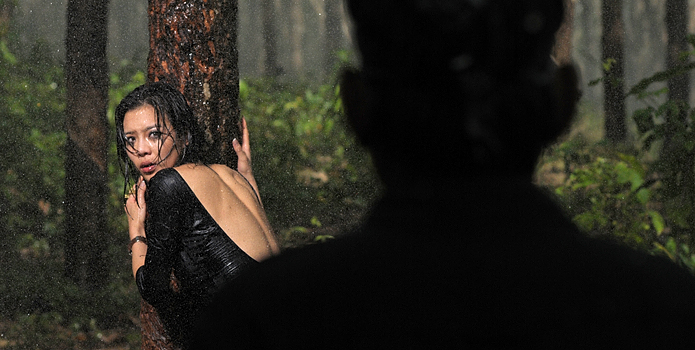
He’s a lover and a fighter, a cop and a killer, a Buddhist monk and streetwise punk. He’s Tul, and he’s the hero of Headshot, an elliptical hit-man saga from Thailand’s Pen-Ek Ratanaruang. Every few scenes Tul seems to be playing a different role, which could be a nod towards Buddhist notions of rebirth, or perhaps just questionable screenwriting. All of this would certainly be more palatable if the different incarnations of Tul weren’t seemingly ripped from some handbook on how to construct a generic crime thriller. The film’s non-linear structure and meditative mood spur a bit of curiosity early on, but the story wraps up in a flurry of contrivance and cliché that essentially kills whatever good will the film had earned up to that point. Oh, and it should be noted that Tul sees everything upside down because of the titular shot to the head, and also that this detail is largely superfluous to the film, short of making it really difficult for the guy to drive. But sure, go ahead, toss another idea into the mix. What’s the harm in one more dead-end concept? It’s not like the film is going anywhere anyway. Wake me when this is reborn as a story I can give a damn about.


