Tuesday, August 31, 2010

Eden Log


Here we have a science fiction film that dares to ask the big questions. Such as: if you were a tree, what kind of tree would you be? If your answer is, “A mystical tree used to power cities and turn people into braying man-pigs with its poisonous sap,” then you’re in luck, because Eden Log is clearly your soul mate. Don’t get me wrong—I love me a bit of ponderous, humourless allegory (honest, I swear!), but everyone has limits, and here are mine. Shot in a murky, drained palette, Eden Log is a reflection in a mud puddle, with all the expected depth. The film moves between scenes of plodding, mostly wordless action in shadowy caverns and equally gray, talky scenes of pure exposition—not the most nimble storytelling technique, you have to admit. Franck Vestiel has a perfectly sensible idea behind his obfuscating stylistics, which is that corporate corruption and dehumanization are rife in society and must be resisted, and this is a moral choice we must all make, and it involves magic trees. But why must Vestiel be so afraid of injecting any sense of personality or character into his solemn signifying? He has a message, but lacks a film, which is equivalent to setting out to sea with cargo but not a ship. Little wonder the whole thing sinks—there’s a lot of weight with nothing to support it.

Sunday, August 29, 2010

Get Low


Who wouldn’t want to attend their own funeral? Count the tears shed, mark attendance, enjoy some free sandwiches—plus, it’s so much more fun than being dead, wouldn’t you agree?

Felix Bush would. After 40 years of living in his remote shack with only a graveyard of deceased pets for company, his idea of a good time has unsurprisingly taken a turn to the morbid. He intends to throw the biggest funeral in four counties, luring people with the promise that he will raffle off his land (300 acres of pristine timberland, he claims), and all he has is one simple request—if you attend, you must tell a story about him.

As an isolated, angry coot, there are surely some colourful legends floating around regarding the man and why he withdrew from civil society in the first place. His only human contact appears to be the local children, who throw rocks at his windows when they’re feeling particularly brave. He’s the local monster, existing in the public’s mind only as a way of frightening the young. In Get Low, director Aaron Schneider sets about to the task of redeeming this forbidding figure and revealing the decency and suffering that are buried somewhere behind that scraggly beard and crazy mountain-man eyes.

The film spells out its redemptive intentions in very clear terms. At the funeral, an old friend of Felix introduces the hermit by declaring that good and evil are not separate, but rather exist in us entangled. In this rather innocuously drifting tale, such a loaded pronouncement appears as if underlined, circled, and with arrows drawn to it from a hastily scribbled note that says—nay, shouts—“THIS IS THE POINT OF THE MOVIE.” So pay attention, will you?

You could be forgiven for not watching too closely until that point. The mystery of Felix’s past—involving a torched house and the deaths of its inhabitants, which Felix may or may not have been responsible for—lends a bit of foreboding to this otherwise sleepy Depression-era tale. The drama is inert, despite some half-hearted complications intended to ramp up interest, but the skill of the actors involved enlivens the film. Robert Duvall, as Felix, is as magnetic as ever, and the film couldn’t function without his uniquely cranky charisma. (As an actor, Duvall has a special talent for making peevishness not seem ignoble. Clearly, this man has a bright future playing weirdo hermits and gummy coots should he so wish.)

And Bill Murray, as Frank Quinn, the greasy funeral director, brings his dependable deadpan to assure us we’re never too far from at least a dry, bemused chuckle or two. Yet despite being largely comic relief, Murray still finds opportunities for little doodles of middle-aged melancholy in the margins of the story. Quinn is shown as a drunkard and divorced man. He reveals himself in moments of sad, lonely desperation, such as when he asks to walk home Mattie (a widow and Felix’s ex-girlfriend, played by Sissy Spacek), only to be rebuffed with a gentle pity that hurts more than any open cruelty.

Such details are sadly rare to the film, which is partly why it’s so underwhelming despite sporting such a banner cast (a sense of detail, particularly regarding secondary characters, is not one of Schneider’s talents, meaning this film built around a single community feels inhabited by about five people and some extras). The other significant problem lies in the clumsy mishandling of the climactic revelations of Felix’s past. Actually, let’s modify that statement: Schneider tanks the entire final third of the film. Felix’s past 40 years were apparently a kind of penitent exile, except that his confession comes wrapped up with a convenient scapegoat—someone guilty of even worse sins—to ensure that he gets his teary reconciliation at the end. If the film intended to show us how good and evil co-exist in one man, then perhaps it should have allowed a bit of actual evil in Felix’s character. Otherwise, his 40 years in the woods are nothing more than one epic pity party.

If I was standing in that crowd at Felix’s funeral, I’d feel a bit cheated at all of this (I suppose, in a sense, the film’s audience is part of that crowd). Imagine: here I had come from across the county to tell my story about the time the loony hermit guy shot at me when I was picking blueberries on his land, and when I get there, all I see is some old guy giving a woe-is-me speech addressed to someone named Mattie (Mattie?), and then there’s a raffle and we all go home. Frankly, I think I would prefer a few tall tales to the mawkish truth.

Wednesday, August 11, 2010

Memories of Murder


Playing out against the backdrop of South Korea’s 1980s pro-democratic public protests, Bong Joon-Ho’s Memories of Murder examines a grisly series of unsolved murders in the city of Hwaseong. It’s a ripped-from-the-headlines tabloid tale with style and intelligence to spare, even if does initially feel overweighted with the clichés of the moribund serial killer movie. We’ve got two rival cops—one who plays by the rules, and one who, of course, does not—and an unidentified murderer whose violence involves all sorts of arbitrary gimmicks, in this case the requisite that each murder be triggered by hearing a specific song on a rainy night and then encountering a woman wearing red. A happy confluence of these elements occurs more often than you would think, although I wonder how many rainy evenings he must have squandered looking for a red dress, or how many times he must have heard that song on a sunny day while watching crimson-bedecked ladies strolling past his front yard, so frustrated he just wanted to cry. The secret meaning of this film is that obsessive-compulsive disorder is not necessarily a detriment to achieving your dreams.

Okay, that’s just one secret meaning of this film. The other is that Kafka’s The Trial is possibly even more disturbing when told from the perspective of the prosecution. In Memories of Murder, police terrorize citizens into confessing to crimes, brutishly manufacturing guilt when there is none to be found. At first, a mentally challenged young man is manipulated into a confession, and then a pervert with a fondness for red underwear and deep-woods self-abuse is picked as a likely killer. But no matter how the police try to make it so, no one in the town seems to be actually guilty. The violence becomes a sign of the police force’s failure as they flail against an opponent they can’t defeat. They’re impotent authority figures—a point that Bong emphasizes, rather sardonically, when one of the detectives is forced to amputate his leg (his good one, too, the one he uses to kick the shit out of suspects). The real perversity of this film is that Bong tells this story from the perspective of the cops, creating a haze of empathy that almost lets you forget that these guys are forging evidence and torturing people in the police station basement. Such is life in a police state: the guilty live free, while only the innocent suffer.

Saturday, July 24, 2010

Toute la memoire du monde


One might think a short film about a library could only be dry, but you should never discount the fertile imagination of Alain Resnais. Toute la memoire du monde, a 1956 short from Resnais, turns France’s Bibliotheque Nationale into a filmmaker’s playground of corridors and shadows, littered with impassive statues watching over little anonymous people who scuttle about like beetles. The institution—made into something enchantingly unreal by Resnais’ prowling camera—is alternately fortress, prison, hospital, and hive, filled with “paper-crunching pseudo-insects” (the film's charming description of readers). The collective memory of mankind is regarded with awe and even a touch of dread. There's a tone of droll wonder that is nicely accentuated by Maurice Jarre’s playfully sinister score and Remo Forlani’s witty script. The seeds of the feature-length masterpieces Resnais would make a few years later are found here, but this spryly intelligent short is more than a dry run for Hiroshima Mon Amour and Last Year at Marienbad. It is a startling piece of work in its own right, bursting with humour and insight, dropping small gems of lyrical wit along the way (the card left behind when a book is checked out is “its ghost,” the syringe used to squirt glue into damaged volumes “inoculates” the book). Does the secret of happiness lie buried within one of these haunted tomes, as the film suggests? Perhaps—or perhaps you need look no farther than this intensely pleasurable little film, which dexterously excavates the mystical from the mundane.

Sunday, July 18, 2010

Inception


Lo and behold, it’s the last original idea in Hollywood—tread carefully, lest this rare beast become startled and disappear back into the smog from whence it came. As a rare big-budget film that is neither a sequel nor based upon an old television show, Inception earns a lot of good will right from the start. True, Christopher Nolan’s story of dream thieves trying to plant an idea in the mind of the heir to a giant business empire is completely convoluted, but I’m just happy to see a blockbuster that taxes my brain and not just my senses. Too bad the film totally squanders charismatic performers like Ellen Page and Joseph Gordon-Levitt on expository sidekick roles and features Leo DiCaprio doing his typical sad-sack tortured husband routine (better than Shutter Island, for what little that’s worth). It’s an intriguing dream, yet it fades too quickly once you wake up.

Only a supremely disciplined and organized mind could hold together Inception’s complex dream-within-a-dream-within-a-dream narrative, but rationality can be a bit of a liability when dealing with the subconscious. Save for a few bursts of ostentatious special effects—a street folds on top of itself, a series of Parisian shops explode in slow motion—the dreamscapes are mostly just generic action-movie set pieces, each feeling like another level in some videogame (I’m pretty sure I already played this snow level in Modern Warfare 2). The film’s excuse is that these are collective dreams, designed by an architect and then dreamt by another. They’re meant to be generic, because anything too unique or weird draws the attention of the dreamer’s subconscious—here represented by an impersonal horde of everyday people that descend upon intruders with the implacable violence of a zombie mob. Show a bit of ingenuity and the crowd is likely to turn on you. Too much personality, too much creativity is dangerous in these blockbuster dreams. And if that is Nolan’s view of the audience and his role as an architect of dreams, is it really surprising that he should build such an elaborate labyrinth of a film to hide within?

Friday, July 16, 2010

Project Grizzly


If I were to encounter a grizzly bear—and somehow live to tell the tale—I suspect I would be changed by the experience, and probably not for the better. Most likely, I would become some sort of paranoiac anti-wilderness freak, never daring to set foot near anything that remotely resembles teeming, uncontrolled nature. City parks would reduce me to an irrational, sniveling terror. Friends would turn away in disgust as I preached the virtues of clear-cutting and forest fires. Teddy bears would send me into a rage with their vile pro-ursine propaganda.

But when Troy Hurtubise encounters a bear and is mysteriously spared, he is changed in a far different manner (though one could still debate whether or not for the better). Instead of recoiling from nature, Troy faces it head on, dedicating his life to building a suit that can withstand the assault of a grizzly. Now, as Troy lumbers about in a nearly 200-pound shell of titanium and chain mail, all I could think is one thing—what the hell is the point of this lunacy? Is he planning to walk up to a bear and punch it in the nose?

Project Grizzly dedicates itself to chronicling this baffling quest in all its absurd yet compelling glory. The film employs a somewhat cheeky tone at times, courtesy of director Peter Lynch, who seems bemused as much as he is fascinated with this man’s zealous project. When Troy and company ride into the Rocky Mountains to field-test the suit, the score turns martial, gently mocking the men’s pretense to wage war against the natural world. Nature, of course, remains completely indifferent to the petty games of men, and the group spends a week in the mountains without spotting a single bear. Only as they leave does a grizzly finally appear, but by then the suit is abandoned under a blanket of snow and playtime is over.

Lynch doesn’t try to overanalyze Troy’s obsessions, although he does allow for some tantalizing explanations. The paternal relationship is trotted out as one possibility, as the film reveals Troy’s father spent three years building a full-size re-creation of an Iroquois village (maybe monomania is genetic?). The father-son dynamic that Lynch emphasizes is almost mythic: a son seeking approval from his now-departed father. Beneath the idolization of the father there are hints of tension, and it’s hard to tell if Troy is driven by a need to live up to his father’s example or simply surpass him entirely. Notably, Troy’s nickname for the bear that almost killed him is “The Old Man.” His relationship to the animal is a mixture of awe and antagonism—a tender anger that mirrors his own relationship to his father.

If this sort of Freudian stuff doesn’t light your cigar, there’s always the adrenalin junky angle. Much talk is heard of “the edge,” the potency of adrenalin, and the need to return to that same rush first felt during some life-threatening experience. During the mountain expedition, one of the men—a Vietnam War vet, if you can believe it—talks about a game called “Outrun the Grenade” that he used to play with fellow soldiers during dull moments between battles. It’s basically what you think it is.

How else to explain cringe-inducing but often hilarious footage of Troy testing different incarnations of the suit by submitting himself to all sorts of punishment? He is rammed by a truck, battered by a log, and thrown down the Niagara Escarpment. At one point, he invites several burly bikers to beat him up with their bludgeons of choice. After their baseball bats splinter apart, he takes off his helmet and does a merry little jig to celebrate. When the log knocks him flat, he tells everyone he feels fine—better than he did before the log hit him, in fact, since his arm had fallen asleep but is now awake again.

So Troy is clearly a bit of a nut, if a charming one. These sort of charismatic monomaniacs are the bread-and-butter of the documentary form (see Man on Wire for another good example of this type of film): voluble types, somewhat self-absorbed but capable of an intense passion most people will never know. During the mountain expedition, it’s hard not to fall under the spell of Troy’s personality. As a raconteur, he’s first-class. His retelling of the bear encounter that changed his life is pure theatrics. He relives the memory as he recounts it, even throwing himself on his back when he describes how the bear knocked him down. At another point, he goes on a lengthy rant about the two knives he carries, explaining how they are necessary for protection from animals of the two-legged—as opposed to four-legged—variety. There are some real crazy folks up in the mountains, he tells us (yeah, no kidding). He then shows us how one knife is better for stabbing, while the other is for throwing.

Of course, you know that he has never had to stab a deranged mountain dweller—it’s not like there are scores of violent survivalists hiding in Banff National Park, for god’s sake—and most likely never will. This is all a lot of bluff and preparation for a threat that only really exists in his head, much as the suit is preparation for an encounter with a bear that will never come. His ambition and drive are impressive, but it’s disturbing to consider that this life-path borders so close to self-destruction (a cursory online search reveals he has already been bankrupted once by this project).

Still, there’s no denying that the suit is an incredible piece of work. Troy may be a mad mountain-man Ahab hunting his land-bound Moby Dick, but that doesn’t mean he can’t achieve great things, right? This film is pure charm, but it also illustrates the simultaneously creative and destruction power of obsession, which threatens to ruin this man’s life even as it drives him to great lengths of ingenuity. Even if reality never obliges him with the flesh-and-fur foe he craves, Troy will soldier on. Perhaps we should just be grateful that someone out there is willing to put so much effort into handling the ursine threat. After all, while he tinkers with his suit, who knows what the grizzlies are planning?

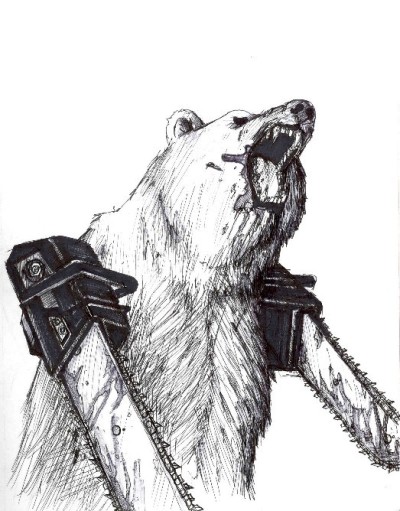
Just consider this: bears with chainsaws.

So who’s the crazy one now?

Sunday, July 4, 2010

Please Give


Most of the problems with Nicole Holofcener’s Please Give—a dyspeptic comedy-drama with little flair for either—can be summed up with a single scene. Kate (Catherine Keener), a vintage-furniture dealer riddled with guilt over her privileged lifestyle, returns a gaudy vase to its original owner because she discovers it is worth far more than expected. The man is startled by the gesture, thanks her profusely, and shuts the door. She walks away fairly glowing. Dimly on the soundtrack, we hear him shatter the vase, calling it junk.

There are two possibilities here. First, that the man is doing something utterly baffling and ridiculous—shattering a valuable vase in his living room just because it’s ugly—simply because Holofcener needs to score points against her characters. Second, that these people are aliens and this bizarre ritual would be perfectly understandable if only we could also breathe their rarified Martian air. Mundane reality, when portrayed so ineptly, becomes science fiction.

The modest premise of the film is that Kate and her husband Alex are upper-middleclass vultures, waiting for their elderly neighbour Andra to die so that they can knock out a wall and expand their apartment. While Kate’s guilt drives her to weird gestures like the vase incident, Alex is more pragmatic about his place in the food chain. Unfortunately, Holofcener tries to develop this schematic set-up (emotional woman versus rational man) with poorly realized complications, like Alex’s fling with one of Andra’s granddaughters. May the movies never again see so passionless and pointless an affair, which will neither echo through the ages nor ever besmirch my DVD player.

So I’ll break it down for you, nice and neat: the cold pragmatist learns to feel, and the sensitive type learns to not, which means everyone learns something, yay for learning (yay!). I’ve learned that it’s a horrible burden to be wealthy, successful, and happy (thank god I’ve dodged that bullet so far, whew), and I’ve learned that the best way to make such an asinine moral palatable is to resort to a lot of weepy, tinkly-piano scenes of characters hugging and telling each other that they’re good people.

I suppose there is some value to pointing out that aimless guilt does little to improve either the world or your own life. But why does a film supposedly hewn so close to life have to spend its last twenty or so minutes wallowing in pure Hollywood la-la-land nonsense? Everyone gets what they want. Kate finds release from her guilt in the joy of others. Alex’s affair ends as effortlessly and painlessly as it began. Finally, the pair buy their daughter some expensive jeans and smile beatifically in a glowing light that suggests they’re about to beam up to their spaceship and return to the planet from which they came. Farewell, friendly aliens! Enjoy your souvenirs!